

What is an invitation to tender (ITT)?

An invitation to tender (ITT) is a formal procurement document that asks suppliers to submit a priced tender for a specific contract. It sets out the buyer’s requirements, instructions, evaluation criteria, timetable, and the terms and conditions that will apply. For suppliers, the ITT is the point where you prepare and submit your full bid, often after selection or in an open procedure, and the buyer uses it to compare offers in a structured and auditable way.
The Invitaiton to Tender (ITT) marks the beginning of many public sector tender processes. Understanding ITTs is crucial for crafting a persuasive response with evidence, pricing, and compliance documents.
In this guide, we will unpack what they are and how to improve your bidding success.
What is the purpose of an Invitation to Tender (ITT)?
The purpose of an ITT in public procurement is to establish a fair, transparent, and auditable process for selecting a suitable supplier. Through this document, buyers set clear expectations for how a contract will be performed. For bid writers and procurement teams, mastering ITT responses is a way to showcase expertise and commercial offer, which form the basis for the final award decision.
What an ITT must include
While the precise structure may vary among governmental departments and local authorities, a compliant ITT provides bidders with a complete framework to create a response. Essentially, you should expect to find:
- Background description summarising the purpose and expected outcomes.
- Submission instructions covering formats, deadlines, and channels.
- Evaluation criteria outlining how bids will be assessed.
- Commercial and legal terms governing the contract, if awarded.
Getting familiar with these components is the initial step in building a compelling and optimal ITT response. Together, they ensure transparency for buyers and allow suppliers to tailor their proposals for maximised scoring potential.
When is an ITT used (and why it matters)
Public sector buying organisation don’t issue ITTs for every purchase, but they’re mandated for many contracts when contract values exceed certain procurement thresholds set by procurement regulations. This means high-value, complex contracts must be awarded through competitive tendering rules rather than informal negotiations.
There are some exceptions where an ITT is not required, including under framework agreements and, previously, under the Public Contract Regulations Act of 2015, using VEAT notices.
For suppliers, ITTs provide a transparent route into high-value contracts. Stotles helps vendors prepare earlier by surfacing early buying signals and buyer activity trends, giving a clearer picture of upcoming opportunities before procurement formally starts.
You’ll see ITTs in open tender ender processes for contracts buying:
- Construction and infrastructure development
- Healthcare procurement
- IT systems and office supplies
- Public-funded and local government projects
Alternatively, long-term, repetitive purchases can be completed under framework agreements without the need to run a new tender every time.
Learn more about frameworks in our guide, government procurement service frameworks.
Further type of buying include dynamic purchasing systems and the competitive flexible procedure to increase thoroughness in procurement.
How is the Invitation to Tender regulated?
Previously, under the Public Contracts Regulations 2015 (PCR 2015), formal ITTs were required for contracts above set financial thresholds for supplies, services, and works. Authorities were required to adhere to defined procurement procedures and provide all necessary instructions for preparing a response. These rules emphasise non-discrimination and accountability in the evaluation and award process.
ITT regulation has now been moved under the new Procurement Act 2023, which introduces terminology updates, flexible procurement tools, and more reporting requirements.
Particularly, some definitions have been adapted to UK-specific terms, such as replacing “Invitation to Tender” with “Tender Notice.” During the transition, it’s vital to stay aware of both regimes, especially when the old rules still apply for ongoing tenders.
ITT vs RFP vs RFQ vs PQQ
You may encounter various acronyms in public sector procurement. Sometimes, they’re used interchangeably, but each signifies a specific stage or process. Distinguishing between an Invitation to Tender (ITT), a Request for Proposal (RFP), a Request for Quotation (RFQ), and a Pre‑Qualification Questionnaire (PQQ) is crucial to understanding what buyers are asking for.
Key components of an ITT document
Beyond a request for bids, an ITT in the tendering process is a carefully assembled package that explains the buyer’s needs, lays the rules for engagement, and defines how achievements will be measured.
Introduction and background
Buyers provide the context for the procurement by introducing themselves, their strategic goals, and why the contract is being tendered. The introduction section often signals key priorities and pain points, giving you a narrative to tailor your response accordingly. This part sets the stage for the entire ITT.
Scope of work / Technical specification
The most central part of the ITT is the detailed description of the exact goods, services, or works you’re required to deliver. Possible specifications may include KPIs, technical requirements, quality assurance, and service-level agreements. Your response must meet or exceed these expectations with sufficient supporting evidence that demonstrates your capability.
Instructions to bidders (submission rules and format)
As the rulebook, this section contains non-negotiable instructions for bid management and on how bids must be submitted, such as via email or an online portal. It also sets formatting style, word limits, font size, file naming conventions, and a precise date and time for submission. Overlooking these rules often leads to immediate disqualification.
Evaluation criteria and scoring (MEAT, Quality, Price, Social Value)
Authorities must provide a marking scheme and explain how bids will be evaluated. Score weighting is arguably the most important factor in strategising your response. One of the common evaluation models is the Most Economically Advantageous Tender (MEAT), which balances your expertise and methodology, pricing schedule, and the greater benefits to the community and environment.
Commercial requirements and pricing
Here, you’ll find pricing structures, payment terms, and commercial expectations. Suppliers are required to provide transparent pricing and demonstrate value for money in alignment with the commercial terms laid out in this section. Hidden costs can weaken your bid, so ensure it’s not only competitive but also consistent for a fair comparison.
Legal terms
A draft contract must be included, detailing contractual terms and conditions governing the relationship between buyers and suppliers. It might cover liabilities, intellectual property, data protection, termination clauses, and dispute resolution. It’s essential to review this part carefully and account for the risks in your bid, as you’re expected to accept these terms if awarded the contract.
Required documentation and compliance
The ITT will typically list all mandatory supporting documents, such as health and safety policies, case studies, equality statements, insurance certificates, and financial accounts. This section aims to ensure compliance and credibility, so missing any documentation may result in automatic rejection.
Tender timeline
Finally, the key dates must be set out clearly: publication, deadline for clarification questions, bid submission due date, evaluation period, and award notification. Public-sector tender timelines are strict. Stotles helps keep teams aligned by centralising tender updates, tracking deadlines, and providing notifications, ensuring no key milestone is overlooked.
By examining each component of the tender invitation, suppliers will see that ITTs aren’t just mundane paperwork, but a blueprint for winning contracts. You should read between the lines, follow instructions closely, and build answers that resonate with buyer priorities.
How the ITT fits into the tender process
An Invitation to Tender sits at the heart of a standard open tender. It formally launches competition and sets the rules suppliers must follow.
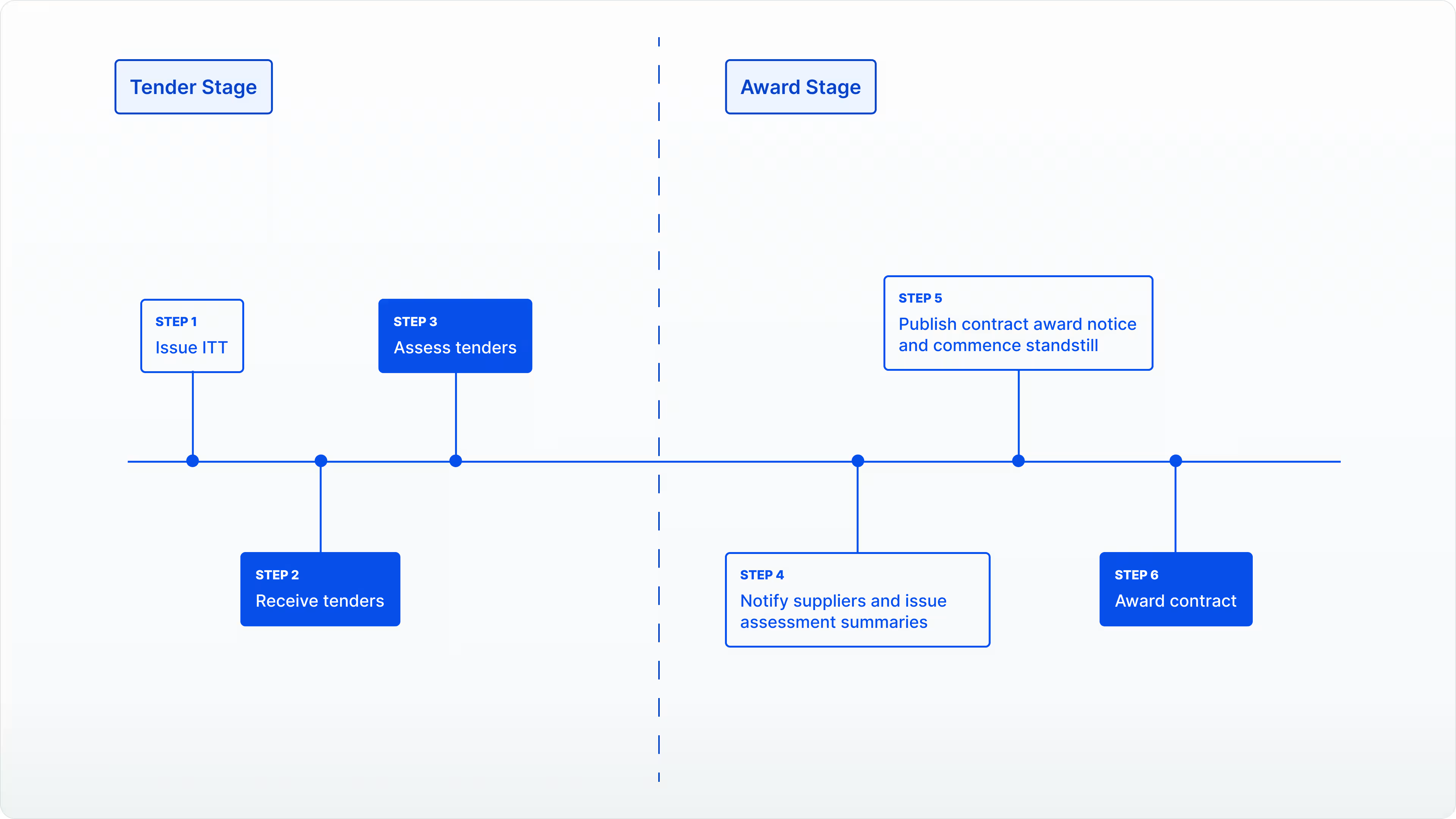
1. Issue the ITT
The buyer publishes the ITT on procurement portals or sends it directly to pre qualified suppliers. This marks the official start of the tender stage and defines scope, requirements, timelines, and evaluation criteria.
2. Receive tenders
Suppliers register interest, review the ITT pack, and prepare their response. Clarification questions are raised during this period so all bidders share the same understanding before submission. Finally, a supplier will prepare and submit a bid in response to the tender.
3. Assess tenders
Once submissions close, the buyer evaluates responses against the published criteria. This typically covers quality, price, and any social value requirements, with moderation to ensure fair scoring.
4. Notify suppliers
Suppliers are informed of the outcome and issued assessment summaries. This gives unsuccessful bidders clarity on performance and confirms the preferred supplier.
5. Publish award and standstill
The buyer publishes the contract award notice and enters the mandatory standstill period. This allows suppliers time to review the decision and raise any challenges.
6. Award the contract
After standstill ends, the contract is formally awarded and delivery can begin.
Common ITT scoring models explained
To boost your chance of delivering a high-scoring bid, understanding how your response will be marked is fundamental. Public sector buyers often rely on transparent scoring models to ensure objectivity and effectiveness in evaluating ITT responses. The most frequently employed frameworks include:
- Most Economically Advantageous Tender (MEAT): Select the best combination of quality, price, and social value.
- Quality/price weighting: Assign percentages to quality and price, such as 60% quality and 40% price.
- Pass/fail criteria: Check if a requirement has been met or not.
Grasping these models empowers you to strategically allocate effort to where your bid scores the most points.
How to write a strong, buyer-aligned ITT response
Submitting a tender that has a chance to win a contract is contingent on following the requirements laid out in the ITT. Throughout the ITT, there are specific instructions that must be heeded and clues as to what a winning response will require to be awarded the contract.
Understand the specification and scoring
Before writing the first sentence, you must read and understand the ITT document thoroughly. Go beyond the surface level and identify the buyer’s underlying objectives. Pay close attention to score weightings as well. If the quality counts for more than 60%, you should primarily focus on crafting impactful answers.
Use evidence, not generic statements
Avoid using vague statements like “we are the industry leader” or “we deliver outstanding services” since every competitor would say the same thing. Instead, substantiate each of your assertions with metrics, case studies, and testimonials. Evidence is your strongest alliance when it comes to building credibility and reassuring the contracting authority of your expertise.
Follow word counts and formatting rules
ITTs impose strict guidelines on how you present your written response. Respect word limits, use the given template, and submit through the specified portal. Exceeding a word count suggests negligence and may lead to automatic elimination. Compliance, on the other hand, demonstrates professionalism and signals your ability to adhere to contractual details later.
Provide clear, transparent pricing
Complete the pricing schedule by breaking down costs logically without any space for ambiguity or assumption. Unclear cost structures and hidden fees may raise red flags about your business and can undermine even the most technically compatible proposal for the project.
Align every answer with the evaluation criteria
Winning responses are those that map directly into the buyer’s scoring framework. Ensure each section addresses a specific criterion. If social value is prioritised, highlight the community benefits that your proposal offers. This allows you to earn every valuable point, strengthen your competitive edge, and make your bid impossible for the evaluator to ignore.
Common mistakes suppliers make in ITT responses
Even the most experienced bidders may stumble on avoidable pitfalls. To steer clear of errors that may derail your bid, stay aware of:
- Using overly technical jargon that obscures your message.
- Failing to address evaluation criteria or the organisation’s priorities.
- Providing unsubstantiated or inconsistent claims across sections.
Recognising and proactively avoiding these mistakes will help suppliers turn their ITT response from a risky submission to a confident one that catches the eye. Notifications, shared workspaces, and AI-driven qualification assist teams in staying focused and avoiding common pitfalls, such as chasing low-relevance tenders or missing key updates.
ITT template and real-world example
Though every ITT is unique, familiarising yourself with its basic structure is a powerful advantage. Stotles provides users with the necessary tools and data to identify opportunities, access ITT templates, and customise responses more effectively. To bring what we have discussed to life, this section will examine two practical examples that turn abstract guidelines into an actionable plan.
Local authority example
An academic institution in the UK may send out ITTs to call for bidders and tenderers. You can download the Model Invitation to Tender Letter for schools and colleges to review a standard local-authority-style ITT structure.
NHS or Central Government example
The National Health Service England issued a request to tender for the NHS Race & Health Observatory Host Supplier. Download the NHS ITT template to see what central government procurement tender documentation typically includes.
Invitation to tender under the Procurement Act 2023
The public procurement landscape in the UK is evolving with the introduction of the Procurement Act 2023. This reform is designed to simplify processes, enhance transparency, and open opportunities for SMEs and local businesses. For a practical breakdown of how the Act will influence tender volumes and supplier opportunities, explore Stotles’ guide to the impact of the Procurement Act on new tender volume.
Under the Act, public sector ITTs follow a new single regime across the UK. The previous “ITT” will be replaced by the new term “Tender Notice.” Transparency is also significantly emphasised by the new rules. Buyers are required to publish clearer notices that disclose more information about how bids are evaluated before suppliers submit their responses.
What stays the same for suppliers
The fundamental role of ITT responses remains unchanged for suppliers. Businesses hoping to bid must still demonstrate compliance, capability evidence, and pricing through a formal document that aligns with the buyer’s terms. Despite the framework evolving, the need for clarity and professionalism in supplier ITT responses remains as critical as ever.
When transitional rules apply (until 2025)
Though the Act received Royal Assent in 2023, transitional rules apply until October 2025. Procurements launched before this time still follow the old EU-derived PCR 2015, while some others might have already adopted the new framework. This means vendors may encounter both the old and the new tender documents, making it essential to be fluent in both regimes simultaneously.
Conclusion: How to Succeed with ITTs
Success in ITT responses comes from mastering the process, preparing answers in sync with the buyer’s priorities, and adhering precisely to the tendering rules. To constantly win contracts, we recommend you:
- Track upcoming opportunities proactively using the Stotles’ guide on how to find public-sector tenders
- Prepare compliance documents in advance
- Align every answer with the scoring criteria
Winning ITTs requires clear alignment with buyer priorities, strong evidence, and full compliance with submission rules. Stotles helps suppliers stay ahead by tracking opportunities, centralising documents, and providing actionable insights into buyer behaviour and competition.
FAQ
What does ITT stand for?
ITT stands for Invitation to Tender, which is a document inviting suppliers to bid on a project.
What is included in an Invitation to Tender?
An ITT usually includes background information, scope of work, technical specifications, submission requirements, evaluation criteria, draft contract terms, pricing expectations, and a list of compliance documents.
Is an Invitation to Tender legally binding?
No, an ITT isn’t legally binding; it’s just a formal invitation. A contract is only signed after the buyer accepts a successful supplier’s tender.
How long do suppliers have to respond to an Invitation to Tender?
Response time depends on the specific rules declared in the ITT’s timeline, which may range from 2 to 6 weeks after publication. This period is mandated by procurement regulations for most public sector tenders.
What’s the difference between an Invitation to Tender and an Request for Proposal?
An ITT is more specific and outlines the exact requirements and standards. It’s often used when the buyer knows the precise goods or services they need. An RFP is generally broader and issued when the organisation looks for innovative solutions to a problem.
Can Invitation to Tenders be challenged?
Yes, unsuccessful suppliers can challenge ITTs if the procurement procedure is believed to have been applied incorrectly. Challenges are often raised during the 10-day standstill period or through legal proceedings.
What is the typical Invitation to Tender evaluation method?
Evaluation is typically performed using weighted criteria, such as the Most Economically Advantageous Tender (MEAT), which enables evaluators to compare bids consistently and award the contract to a supplier that meets criteria like technical merit and social value, alongside overall cost effectiveness.


Want a custom report?