

What is a dynamic market in procurement?

A Dynamic Market is a procurement tool under the UK Procurement Act 2023 that creates an always-open list of suppliers who meet set conditions for membership, allowing buyers to run competitions for specific contracts among members. Suppliers can apply to join at any time, rather than waiting for a framework to reopen. A Dynamic Market is not itself a contract; it is a route to compete for contracts, and authorities must advertise it and set proportionate membership conditions. Authorities can recover certain costs through charges, but rules limit what can be charged and how it is applied.
If you've ever missed the window to get onto a government supplier list, Dynamic Markets are the fix. They're a type of procurement arrangement under the UK Procurement Act 2023 that stays open to new suppliers the entire time it's running, so you don't have to wait years for the next opportunity to apply.
This guide covers how Dynamic Markets work, how they differ from frameworks and the previous DPS, and the practical steps for joining and competing within them.
The UK public sector spends £434 billion a year on procurement — and that figure has grown every year since 2020. For suppliers, the question isn't whether the opportunity is there. It's whether you can get to it.
What is the purpose of a Dynamic Market
Crown Commercial Service (CCS) describes Dynamic Markets as "essentially a list of qualified suppliers who can provide a particular range of products or services." The key word here is "qualified."
Suppliers pass basic checks on finances, insurance, and technical ability. Once accepted, they can compete for contracts as the authority issues them.
Unlike framework agreements, which lock in participants at the outset, Dynamic Markets keep competition live throughout the life of the arrangement. New entrants can apply whenever they meet the published conditions.
The practical difference for suppliers is access. Under a traditional framework, missing the initial application window means waiting years for the next renewal. With a Dynamic Market, you can join an established procurement route as soon as you're ready, rather than sitting on the sidelines until the cycle resets.
Dynamic Markets replaced the older Dynamic Purchasing System (DPS) and are designed to make it easier for businesses, especially SMEs, to compete for public sector contracts.
Note: "Dynamic market" also refers to fast-moving, competitive markets in economics. This article covers the UK public procurement meaning only.
In the below image, you can see the Stotles BETA view of dynamic markets. There are 2,974 Dynamic Markets. in platform.
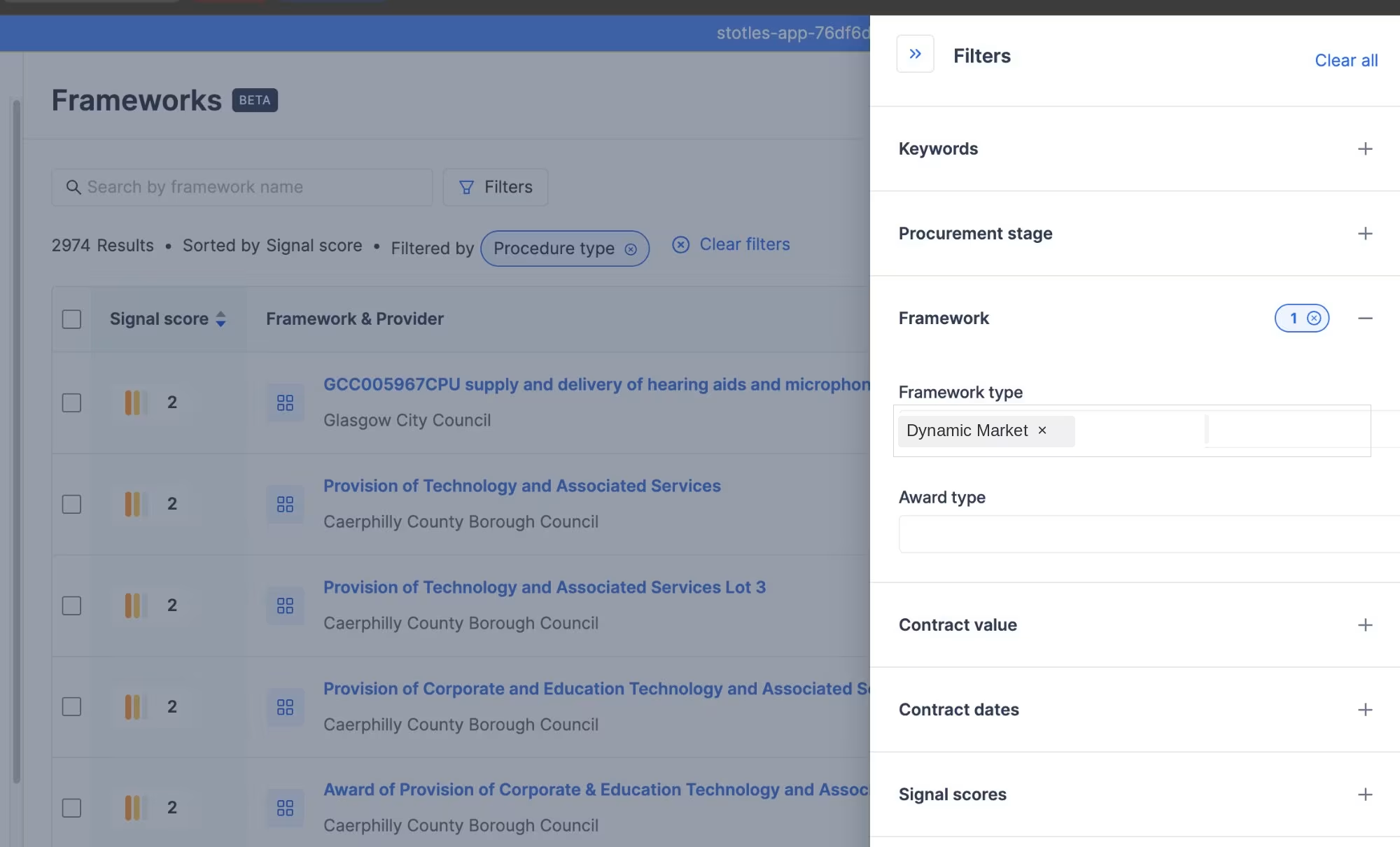
How Dynamic Markets work under the Procurement Act 2023
A contracting authority sets up a Dynamic Market by publishing a notice. The notice describes the scope of goods or services covered and lists the conditions suppliers need to meet. Once live, the market stays open for applications throughout its duration, which can run for several years.
Below you can see a general outline of a dynamic market in use.
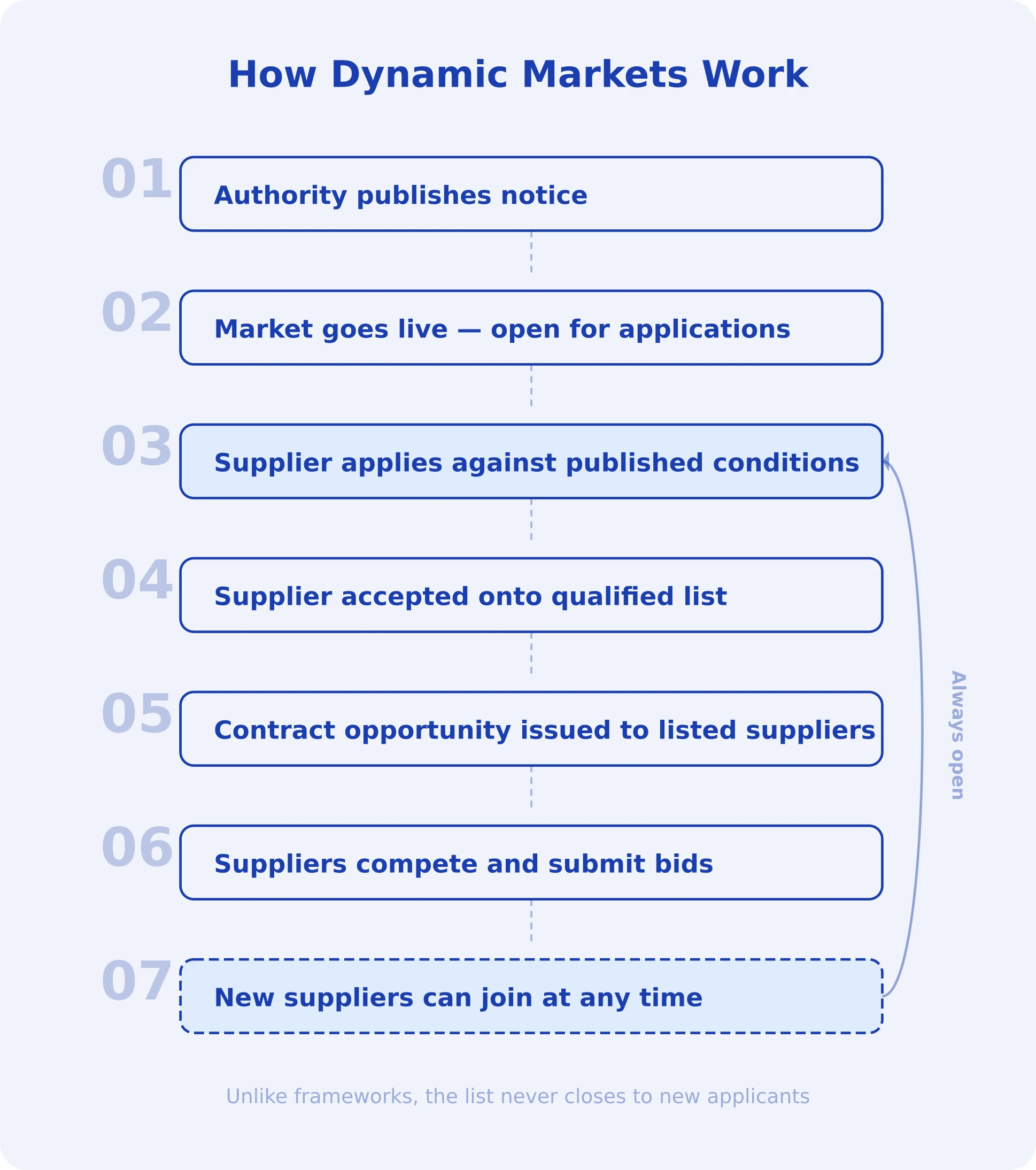
Steps 3–7 form a continuous loop. New suppliers can enter at step 3 at any point while the Dynamic Market is live, while existing suppliers continue competing for contracts as they're issued.
Membership conditions and eligibility
Membership conditions typically cover capability, experience, certifications, or financial standing relevant to the market's scope. A Dynamic Market for IT services might require ISO 27001 certification. One for construction might ask for specific health and safety accreditations.
Suppliers either self-certify against the conditions or provide supporting evidence at application. The threshold for entry is generally lower than a full tender process.
The Procurement Act 2023 requires conditions for membership to be proportionate, with specific protections for SMEs. Authorities can't demand audited accounts from businesses that aren't legally required to produce them, and they can't insist on contract-specific insurance being in place before a contract is awarded. In practice, membership functions as a pre-qualification stage, not a full tender.
Those protections exist for a reason. On G-Cloud, nine in ten suppliers are SMEs — yet enterprises with just 10% of the supplier base take more than half the spend. Lighter entry requirements on Dynamic Markets are designed to close that gap between access and outcomes.
Suppliers demonstrate they meet the conditions, and the detailed competition happens later, at the call-off stage. This makes Dynamic Markets significantly more accessible than frameworks for SMEs, where the initial bid process can require detailed method statements, case studies, and pricing from the outset.
How contracts are awarded within a Dynamic Market
When a contracting authority has a specific need, it runs a competition among listed members. The authority might invite all members to bid, or it might narrow the field to a relevant subset. For example, only suppliers within a particular part of the Dynamic Market based on contract value, geographic area, or service category.
Each call-off follows procurement rules. Awards are based on evaluation criteria specified for that particular contract, not on membership status alone. Being on the list gets you in the room. Winning the work still requires a competitive bid.
Removal and suspension of suppliers
Contracting authorities can remove suppliers who no longer meet eligibility conditions. Poor performance on awarded contracts can also trigger removal, as can exclusion grounds under the Procurement Act 2023, such as serious misconduct or financial instability.
Authorities follow due process before removing anyone. Suppliers whose circumstances change, say a lapsed certification gets renewed, can typically reapply once the issue is resolved.
Dynamic Markets vs Dynamic Purchasing Systems
Dynamic Markets replaced the Dynamic Purchasing System (DPS) under the Public Contracts Regulations 2015. Both mechanisms keep the supplier list open for new entrants, but the Act introduced several meaningful changes.
What changed
The most significant shift is scope. DPS was restricted to commonly used, off-the-shelf goods and services. Dynamic Markets can be used for any procurement type, including bespoke or complex requirements. There's also no prescribed duration limit, authorities can run a Dynamic Market for as long as it serves their needs.
What it means for suppliers
The application process feels broadly similar, but there are practical differences worth noting. Suppliers can now apply to join a Dynamic Market and participate in a live procurement at the same time. If a tender notice is published and you're not yet on the list, you can submit a membership application alongside your bid. Authorities can also structure Dynamic Markets into parts by contract value, geographic area, or service category, which may affect how opportunities are targeted and communicated.
Dynamic Markets vs framework agreements
Framework agreements fix the supplier list at the outset. Once the framework is established, no new suppliers can join until it renews, typically after four years. Dynamic Markets, by contrast, accept new applications throughout their duration.
Entry flexibility and barriers
A supplier that misses a framework deadline faces a multi-year wait for the next chance. The same applies to companies that enter the market after a framework is established, or SMEs that weren't ready to bid when the framework launched.
Dynamic Markets eliminate this barrier. New market entrants, growing SMEs, and suppliers expanding into new sectors can join established procurement routes without waiting for renewal cycles.
Competition and award mechanisms
Framework agreements can allow direct awards to a single supplier without competition, provided the framework sets out the core terms of the contract and an objective mechanism for supplier selection. I
n practice, this means some framework call-offs never go to open competition. A contracting authority can only award a contract directly if the framework sets out the core terms of the contract and an objective mechanism for supplier selection, but where those conditions are met, incumbents can win repeat work without facing a competitive process.
Dynamic Markets don't permit direct awards at all. Section 34(1) of the Procurement Act 2023 makes it clear that a competitive flexible procedure must be used to call off from a Dynamic Market. Every contract requires a competition.
That mandatory competition matters. According to a Stotles supplier survey, two-thirds of public sector sales go to buyers a supplier already works with — a pattern frameworks can reinforce through direct awards. Dynamic Markets break that cycle.
This means more bidding activity for members, but also more chances to win work based on merit rather than incumbency. Suppliers often hold positions on both frameworks and Dynamic Markets in their sector, frameworks offer predictability and pre-agreed terms for repeat purchases, while Dynamic Markets provide a route into new buying relationships and emerging opportunities.
Why Dynamic Markets matter for public sector suppliers
Dynamic Markets create ongoing entry points into procurement pipelines that would otherwise be closed. For suppliers building or scaling a public sector practice, this accessibility can be strategically valuable.
Most suppliers aren't winning work at scale. Over half landed five or fewer contracts in the past year. Dynamic Markets offer a structural route past that bottleneck: ongoing access rather than a single-shot application window.
Benefits of Dynamic Markets for suppliers
- Continuous market access: Join at any time rather than waiting for framework renewals that may be years away
- Lower barriers to entry: Membership conditions must be proportionate under the Procurement Act 2023, and authorities can't demand audited accounts or pre-award insurance from suppliers who aren't legally required to have them. This makes the initial qualification significantly lighter than a full framework bid.
- Pipeline visibility: Listed suppliers receive notifications of upcoming call-offs
- Sector positioning: Membership signals capability to buyers in that category
Risks and limitations of Dynamic Markets
Membership does not guarantee contracts. All members compete for each call-off, which can mean many bidders and intense competition.
Suppliers also face an ongoing administrative burden, maintaining eligibility, monitoring notifications, and responding to relevant call-offs. And not all Dynamic Markets are created equal. Some may generate very few actual contracts, making the effort-to-reward ratio unfavourable.
The commercial value of any Dynamic Market depends on the volume and value of call-offs, the number of competing members, and alignment with a supplier's capabilities. Platforms like Stotles let you research contract history and call-off activity before applying, so your team can prioritise the markets most likely to deliver ROI.
Where to find Dynamic Market opportunities
Stotles tracks all live Dynamic Market notices across UK public procurement in one place, including establishment notices, call-offs, and contract awards. Rather than checking multiple portals manually, you can filter by sector, buyer, and keyword to surface the markets relevant to your business.
In Stotles, you can use filters like procurement stage, contract value, and market type to narrow down Dynamic Market opportunities relevant to your business.
.avif)
If you prefer to go direct to source, Dynamic Markets are published across several official government portals:
- Find a Tender: The central portal for above-threshold procurement notices, including Dynamic Market establishment and call-off notices
- Contracts Finder: Notices for lower-value opportunities and some Dynamic Markets, particularly from local authorities
- Sector-specific portals: NHS Supply Chain, education buying hubs, and regional local government platforms operate their own Dynamic Markets
- Crown Commercial Service: Central government Dynamic Markets covering categories from technology to professional services
Monitoring multiple portals manually creates risk. Notices can be missed, deadlines overlooked, and relevant call-offs buried among irrelevant results. Teams selling to multiple sectors or buyer types often find the administrative burden unsustainable.
How to join a Dynamic Market
1. Find relevant Dynamic Markets in your sector
Stotles aggregates Dynamic Market notices from across UK public procurement, so you can filter by sector, buyer type, and keyword in one place rather than checking multiple portals. You can also search directly on Find a Tender and Contracts Finder. Look for notices with titles referencing "Dynamic Market" or "DM" in your service categories.
2. Review the membership conditions
Each Dynamic Market publishes its conditions upfront. Read them carefully before investing time in an application. Check what evidence is required — this typically covers financial standing, relevant certifications, insurance, and demonstrable experience. Under the Procurement Act 2023, conditions must be proportionate, so you shouldn't face requirements disproportionate to the contracts on offer.
3. Prepare and submit your application
Gather the required evidence: company information, financial statements, references, certifications, and declarations. Most applications include selection questions where you'll need to demonstrate relevant track record. Submit through the portal specified in the notice.
4. Maintain your membership
Acceptance can take several weeks. Once you're on the list, keep credentials and certifications current throughout your membership. Respond to any revalidation requests from the contracting authority. Failure to maintain eligibility can result in removal — though you can reapply once the issue is resolved.
How Stotles helps suppliers track Dynamic Market opportunities
Stotles shows you the context behind each Dynamic Market that government portals don't provide. You can see which contracting authorities are actively using Dynamic Markets in your sector, what they've awarded previously, who the incumbent suppliers are, and how much spend is flowing through each market. This helps you decide which Dynamic Markets are worth joining based on real procurement activity, not just the notice description.
All Dynamic Market notices (establishments, call-offs, and awards) are pulled into a single feed you can filter by sector, buyer type, region, and keyword. Set up alerts and you'll get notified when a new Dynamic Market opens in your space or when a call-off is published on one you're already tracking.
From there, you can track your membership applications, monitor upcoming call-off deadlines, and manage bid status across multiple Dynamic Markets in one place. When a call-off moves to active tender, the buyer intelligence and contract history you've already gathered carries through to your bid team with no duplicate research needed.


Want a custom report?