The Fujitsu Post Office contract is a 30-year procurement story that began as a 1996 Private Finance Initiative (PFI) deal and is now being replaced through a live tender worth around £492m across two lots, with the existing Fujitsu contract extended to bridge the gap. The Fujitsu Horizon system, which wrongfully convicted over 900 subpostmasters, started out as a swipe card project and was salvaged against IT specialists' advice, and is still running in 2026.
Most coverage of the Post Office Horizon scandal focuses on the human cost. This article looks at it through a different lens: the procurement lifecycle.
From the original PFI award, through the bug-fixing cover-ups, to the live competitive dialogue procedure replacing Horizon, the contract story tells you a lot about why public sector procurement transparency matters now more than ever.
Why the Horizon contract sits in the wider PFI story
PFI was abolished by Chancellor Philip Hammond in 2018, but over 650 PFI and PFI2 contracts are still running, with roughly £169bn still to be paid out, which means a wave of replacement procurements is now hitting the public sector market. Horizon is one of the earliest and most important examples.
The Post Office Horizon contract was awarded in 1996, predating modern UK procurement transparency systems and the EU's TED system. There was no central, searchable record of who won it, on what terms, or how the contract was modified over time. That murkiness of the award process is part of the story. As more PFI contracts reach their replacement windows, suppliers and procurement teams now have tools that stakeholders in the original Horizon process never had.
This piece traces the full lifecycle of a PFI contract as a case study of what happens when oversight, supplier accountability, and procurement transparency all break down simultaneously.
How was the original Post Office Horizon contract awarded?
The original Horizon contract was awarded in 1996 to ICL Pathway, a subsidiary created specifically for the project, by the Benefits Agency and Post Office Counters Ltd jointly. ICL ranked last out of three bidders on technical merit but won because it was judged the cheapest option. The contract was a PFI deal to build a swipe card system for benefits and pensions payments at Post Office counters.
By 1999, the Benefits Agency had pulled out of the process. The National Audit Office found the project had cost taxpayers around £700m and identified divided control, insufficient piloting, and poor risk management as key failures. Rather than write off the project, the Post Office salvaged it into a branch accounting system, against the advice of its own IT specialists. The result was Horizon, then described as "the largest non-military IT contract in Europe."
Three elements of this contract wouldn't be permitted under today's procurement rules:
The contract was awarded to a bidder that ranked last on technical evaluation, on price grounds alone. Under the Procurement Act 2023, buyers are now required to weigh innovation, social value, and long-term outcomes alongside cost.
A failed PFI project was repurposed for an entirely different use case without re-procurement.
The contract predates any modern procurement transparency tooling. There is no Find a Tender notice, no TED record, and no centrally searchable award document. The only surviving public record of the original 1996 contract terms is a parliamentary memorandum filed by ICL Pathway three years after the award.
What was Fujitsu's role in the Horizon contract?
Fujitsu inherited the Horizon contract in 1998 when it acquired ICL. Horizon was one of Fujitsu's few profitable UK contracts at the time, and within a few years the company would be bidding for, and winning, work on the £12bn NHS National Programme for IT. Bad publicity or contractual penalties on Horizon would have hurt Fujitsu's wider government bid pipeline.
Richard Roll, a Fujitsu engineer who worked on Horizon support between 2001 and 2004, told the public inquiry that his team's "primary aim was to keep the system up and running so that it worked and so that Fujitsu didn't suffer any penalties." Identifying actual coding problems "was a bonus." The team patched the system as a whole rather than fixing the underlying code. By that point, subpostmasters were already being prosecuted on the basis of Horizon evidence.
By 2006, at least 15 separate bugs and outages had been identified in the Fujitsu Post Office system, with names like the “network banking bug”, “data tree build failure discrepancies”, the “Dalmellington bug”, and the “phantom transactions issue”. Subpostmasters were left to absorb the financial impact of these system outages while head office maintained the line that Horizon was "100% reliable."
Between 2000 and 2013, 736 subpostmasters were prosecuted using Horizon data. More than 900 were wrongfully convicted in total, and at least 13 suicides have been linked to the scandal.
Quick timeline of the Horizon contract
Year
Event
1996
PFI contract awarded to ICL Pathway
1998
Fujitsu acquires ICL, inherits the contract
1999
Benefits Agency pulls out, project repurposed as branch accounting system
How did the Post Office cover up the contract failures?
Three internal reviews into Fujitsu's remote access to branch accounts were buried by the Post Office between 2014 and 2016, even after evidence emerged that Fujitsu staff could alter subpostmaster accounts without their knowledge. This is where the Horizon story stops being a software scandal and starts being a procurement governance failure.
The three killed reviews:
Project Zebra (Deloitte, 2014)was commissioned by the Post Office and identified two separate ways Fujitsu staff could alter branch accounts, including the use of fake digital signatures to delete, create, or amend transaction data signed by subpostmasters. The findings were never disclosed to Second Sight, the independent investigators reviewing prosecutions.
The Swift Review (February 2016), commissioned by incoming Post Office chair Tim Parker at the request of Post Office minister Baroness Neville-Rolfe, was conducted by Jonathan Swift QC. Swift found Horizon "occasionally suffer[ed] from bugs which have caused losses in some branches" and warned that miscarriages of justice may have taken place. He described the Post Office's practice of pressuring subpostmasters into guilty pleas as "a stain on the character of the business" and made eight recommendations for further investigation. The review was kept secret, held only in paper copy by four people.
The Deloitte follow-up investigation (February to June 2016) was set up to trawl all Horizon transactions since 1999. Ministers, including Sajid Javid and Baroness Neville-Rolfe, were told it was under way "to address suggestions that branch accounts might have been remotely altered without complainants' knowledge." It was killed in June 2016 on what the BBC reported as "very strong advice" from leading counsel, after subpostmasters launched their group litigation.
In 2019, Mr Justice Fraser's Common Issues Judgment found the subpostmaster contract terms "oppressive" and the Post Office guilty of "oppressive behaviour." His Horizon Issues Judgment confirmed the system was "not remotely robust" and contained "a significant number of bugs, errors and defects."
The procurement lesson is uncomfortable: the same body running the prosecutions was also managing the supplier relationship and commissioning (then cancelling) its own technical reviews. There was no independent commercial oversight. Modern procurement frameworks increasingly try to design this conflict out, but in 1996, it was simply how a PFI contract worked.
Today, every contract modification, performance notice, and supplier review is published under the Procurement Act 2023, with KPI data on contracts above £5m made public. Tools like Stotles aggregate that data into a single supplier view, making this kind of off-the-books governance much harder to repeat.
What is NBIT and why did the Post Office scrap it?
NBIT (New Branch IT) was the Post Office's in-house Horizon replacement project, scrapped in late 2024 after new chair Nigel Railton said it was "set up to fail." The Post Office had announced its intent to move off Horizon in April 2021, when then-CEO Nick Read laid out the replacement plan. NBIT was meant to be the answer.
Costs and complexity ballooned. By the time Railton took over, the project had become so unwieldy that he told the inquiry NBIT had been "set up to fail." The Post Office pivoted to buying off-the-shelf software from external suppliers instead, which is the procurement approach now playing out in the live replacement tender.
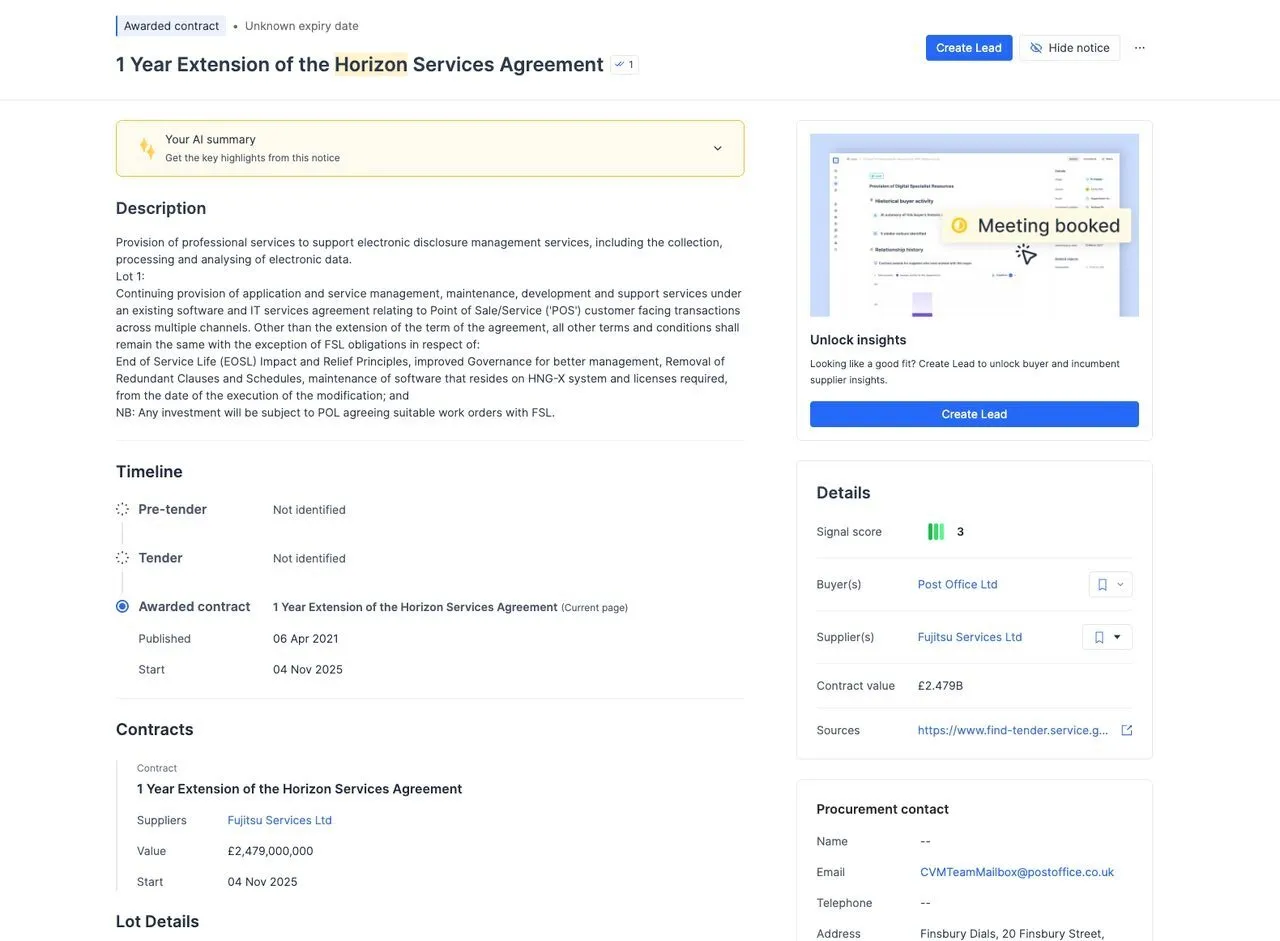
In the meantime, the Post Office kept extending its Fujitsu contract:
Industry coverage suggests the contract could stretch further as the replacement programme progresses
Computer Weekly has reported that the current Horizon system could remain in some form until 2033, depending on how the replacement migration goes.
Fujitsu's wider UK government contract footprint
Despite the scandal, Fujitsu continued winning UK government work for years. Computer Weekly reported in April 2022 that Fujitsu had bagged £430m in government contracts in a single month, even as the inquiry was building. Following the ITV drama in January 2024, Fujitsu publicly committed to pause bidding for new UK government contracts, although it continues to fulfil existing ones, including the Horizon extensions.
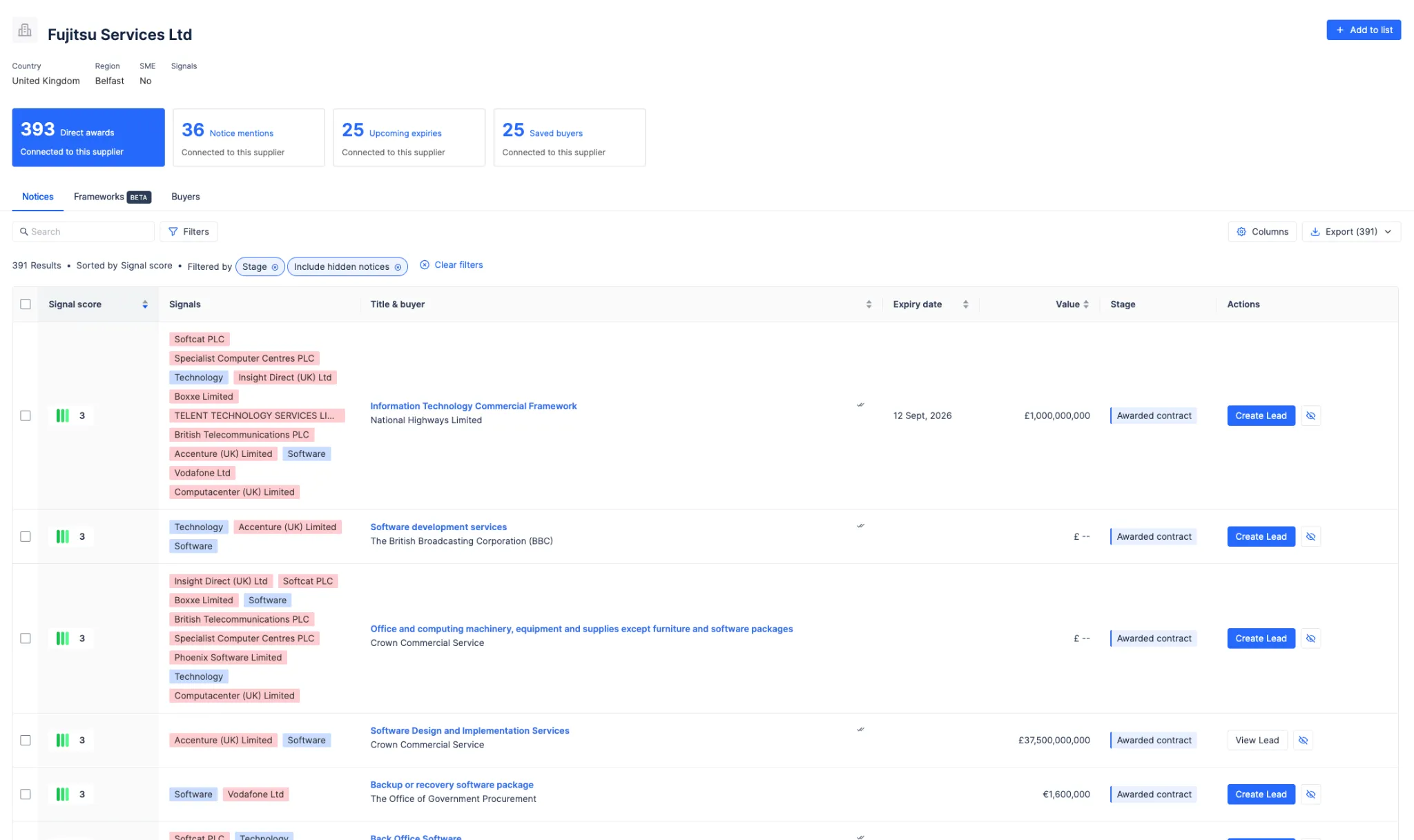
According to Stotles' UK public sector procurement data, Fujitsu Services Ltd has won around £658m in central government technology contracts, placing it among the top five suppliers in the sector despite the Horizon scandal.
That breadth matters for two reasons. First, it indicates that procurement decisions regarding Fujitsu have been made across multiple departments, not just at the Post Office. Second, it shows why supplier-level contract intelligence matters when you are bidding into the same departments. If you are competing against, partnering with, or trying to displace Fujitsu in central government, knowing the full shape of their footprint changes how you position yourself.
What does the Horizon Replacement tender involve?
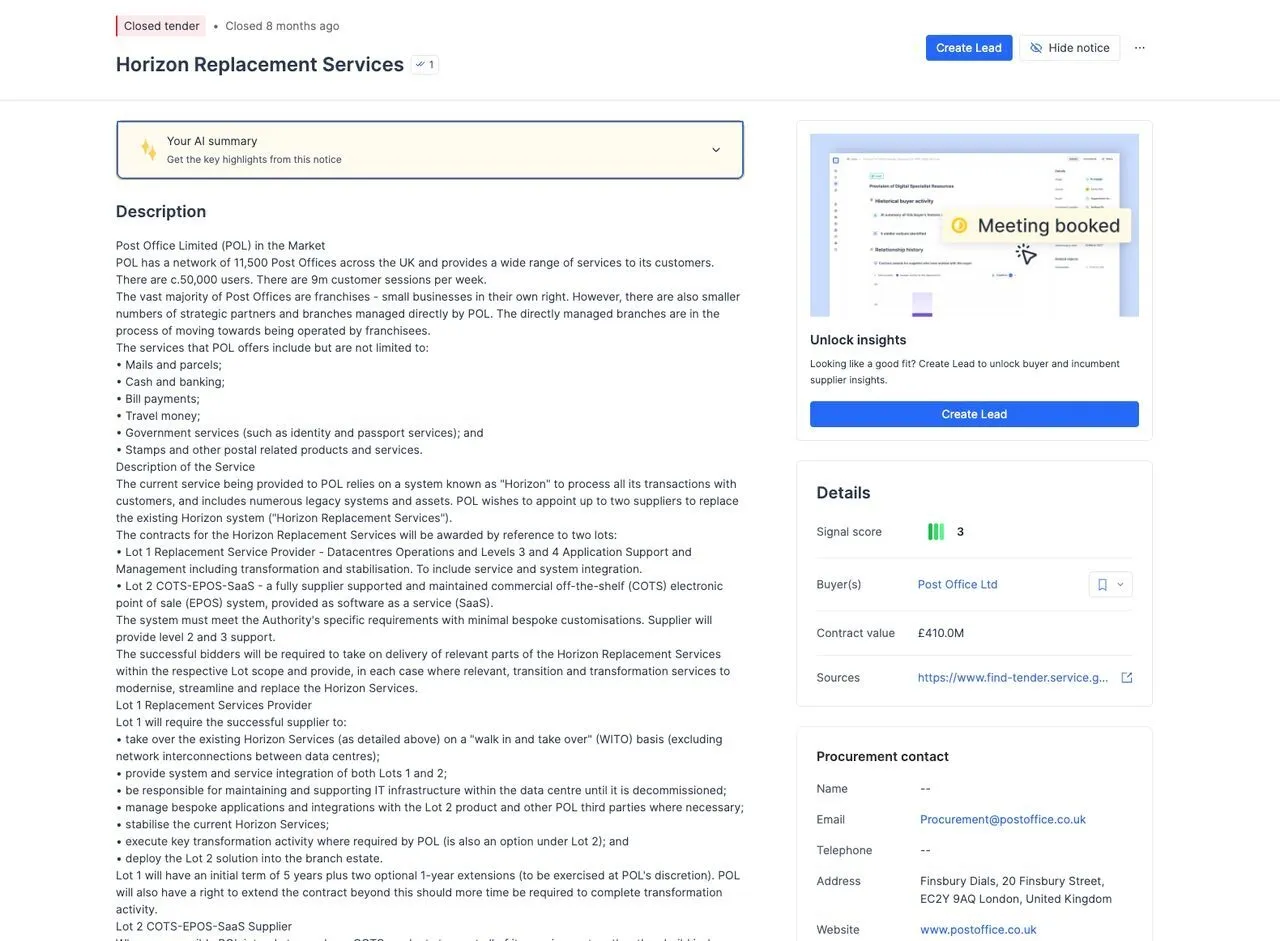
The Post Office's newest move to replace Horizon was published in 2025 as the Horizon Replacement Services tender, split into two lots and procured under a competitive dialogue procedure under the Procurement Act 2023. The total programme is estimated at around £492m. Lot 1 covers the replacement service provider, Lot 2 covers the off-the-shelf EPOS software. The Post Office expects to award Lot 1 by July 2026.
Here is the structure side-by-side:
Lot 1: Replacement Service Provider
Lot 2: COTS EPOS Software Provider
Scope
Datacentre operations, application support, cloud migration, walk-in and take over from Fujitsu (WITO basis)
Off-the-shelf electronic point of sale software to replace Horizon
Initial term
5 years
10 years
Optional extensions
2 x 1 year
2 x 1 year
Approximate value
~£323m
~£169m
PSQ deadline
August 2025
September 2025
Procurement procedure
Competitive dialogue
Competitive dialogue
The top six highest-scoring PSQ bidders per lot will be invited to submit an Initial Tender. An earlier Planned Procurement Notice (UK3), Multi-Sourcing of Horizon IT Services, published in May 2025, gives suppliers further context on how the Post Office is structuring the wider replacement programme.
This is a competitive dialogue, not an open tender. Pre-engagement matters more than the final bid response. Stotles customers track buyer decision makers and pre-tender notices to engage 6 to 12 months before the formal RFP drops.
Lot 1 and Lot 2 will create a multi-sourcing environment. The supplier dynamics on day one of the new contract are going to be very different from the single-Fujitsu setup of the past 30 years.
The Procurement Act 2023 brings stricter supplier performance tracking. Whoever wins these lots will be operating under a transparency regime the original Horizon contract never had.
Why is the Horizon system so hard to replace?
The £41m extension notice itself describes Horizon as a "highly complex legacy platform" written in "outdated versions of software languages" with an "inflexible, monolithic architecture" that makes it difficult to adopt new technology. The line that really stands out from the notice: "It would not be possible to simply hand this system over to another supplier."
That is remarkable for the Post Office to include in a public procurement notice while running a replacement procurement at the same time. It tells you the migration risk is being priced into both sides of the deal. The extension is buying time, and the replacement programme is being structured around the assumption that any incoming supplier will need to manage years of parallel running. The cumulative cost shows it: the latest extension brings the total Horizon engagement value to nearly £3bn over its 30-year lifespan, up from the originally projected £1bn.
It also raises a structural question: if Horizon was this hard to move away from, what stops the same lock-in happening with whoever wins the new contract? The competitive dialogue procedure gives the Post Office room to push for modular architecture, exit clauses, and data portability commitments that the original 1996 contract never had. Whether they actually do is the thing to watch.
Who is bidding for Lot 1?
Computer Weekly reported in March 2026 that IBM is bidding for the Lot 1 work, with DXC as a partner. IBM had been part of an earlier £100m multi-supplier contract that began in 2013 to replace Horizon, but the project was cancelled in 2015 after, in Computer Weekly's words, "things got complex" and Post Office directors "went crawling back to Fujitsu." The Post Office had to pay IBM millions of pounds of taxpayer funds for work already done.
So the same supplier that worked on a cancelled Post Office IT programme a decade ago is now bidding to take over the platform that programme was meant to help replace. For procurement professionals, that is the most interesting accountability question on the table. Not just who wins the contract, but whether the structural risks that made Horizon so difficult to move away from in the first place are being properly designed out of the next phase.
If you sell into central government, three things from the Horizon contract story are worth carrying into your strategy.
PFI replacements are a growing pipeline. With around 650 PFI contracts still running and £169bn still to be paid out, the wave of expiry-driven re-procurements is just starting. Tracking these expiries early gives you the longest possible runway to engage buyers before the tender notice goes live.
Supplier-level intelligence beats notice-level intelligence. A single tender notice tells you what is being bought. Mapping a supplier's wider government footprint tells you how they have been winning, where they are exposed, and where their renewal cliffs sit.
The Procurement Act 2023 is changing the rules of engagement. Pipeline Notices (UK1), Preliminary Market Engagement Notices (UK2), and Planned Procurement Notices (UK3) all create new opportunities to engage buyers before a tender is published. The contracts that win in the next five years are being shaped right now, in pre-market conversations.
If you want to track the Horizon Replacement Services tender as it progresses through the competitive dialogue, monitor Fujitsu's wider government contract activity, or get ahead of the next wave of PFI contract expiries, that is exactly the kind of work Stotles is built for. Use the guest passes below to take a sneak peek at what the platform offers.
What happened with the Post Office Horizon scandal?
The Post Office Horizon scandal saw more than 900 subpostmasters wrongfully convicted between 2000 and 2013, based on faulty Horizon accounting data supplied by Fujitsu. At least 13 suicides have been linked to the scandal. Multiple internal reviews into Fujitsu's remote access to branch accounts were buried by the Post Office. In 2019, Mr Justice Fraser ruled the Horizon system "not remotely robust." The public inquiry is ongoing and compensation schemes remain active.
What is the latest update on the Post Office Horizon contract?
Fujitsu still holds the Horizon contract as of 2026. The Post Office extended it by £41m to March 2027 in November 2025, and BBC sources have indicated it could be extended further to 2028. The replacement procurement is live, with Lot 1 expected to be awarded by July 2026.
What is NBIT?
NBIT (New Branch IT) was the Post Office's in-house Horizon replacement project, launched after the April 2021 announcement that the Post Office would move off Horizon. It was scrapped in late 2024 after the new chair, Nigel Railton, said it had been "set up to fail" due to soaring costs and complexity. The Post Office now plans to buy off-the-shelf software through a competitive dialogue procurement.
How big is the Horizon Replacement contract?
The total Horizon Replacement Services programme is valued at around £492m across two lots. Lot 1 covers the replacement service provider on a walk-in and take over (WITO) basis from Fujitsu and is worth approximately £323m, with an initial five-year term plus two optional one-year extensions. Lot 2 covers the off-the-shelf EPOS software and is worth approximately £169m over an initial 10-year term, with two optional one-year extensions.
How can suppliers track the Post Office Horizon Replacement procurement?
Suppliers can track the procurement directly through published notices (Notice 041512-2025 for the live tender, Notice 019874-2025 for the earlier Planned Procurement Notice UK3). Tools like Stotles centralise tracking across all UK procurement portals, send alerts on contract updates, and let you map supplier footprints across the wider public sector to spot related opportunities and competitor activity.