

What is a Call-Off Contract? Definition and How They Work

A call-off contract is a contract awarded under an existing framework agreement that sets the specific goods, services or works, pricing and delivery terms for a particular order. The framework sets the overarching rules and terms, while the call-off creates the binding commitment for a defined requirement. Buyers may award a call-off directly or run a mini-competition among framework suppliers, depending on the framework’s call-off procedure. For suppliers, call-offs are the point where work is confirmed and revenue is secured under pre-agreed framework terms.
Call-off contracts are one of the fastest routes to winning public sector work in the UK. Placed under framework agreements, they let government buyers order goods and services from pre-approved suppliers without running a full tender. For suppliers, understanding how call-offs work, and how to position for them, is the difference between holding a framework place and actually winning revenue from it.
Call off contracts in the UK public sector
In UK public sector procurement, call-off contracts are how government buyers actually spend money under frameworks. For example, central government buyers like Crown Commercial Service (CCS) or the NHS Shared Business Services, as well as regional buying consortia all operate frameworks where individual contracts are awarded through call-offs.
The term "call-off" reflects the action itself: a buyer "calls off" a specific quantity of goods or services from the framework as and when needed. This flexibility works particularly well for requirements that are ongoing, variable, or difficult to predict in advance.
"Call-off order" and "call-off contract" are often used interchangeably in UK public sector procurement. Technically, the call-off order is the instruction or request that triggers a call-off contract under the framework.
In practice, both terms refer to the same mechanism: drawing down specific goods or services from a framework agreement. The distinction matters more in contract administration than in commercial strategy.
How call-off contracts work within framework agreements
Call-off contracts represent a significant portion of UK public sector spending. For suppliers, understanding how they work in the context of frameworks is essential to building a sustainable government revenue stream.
Framework agreements pre-approve suppliers and sets the commercial terms. A call-off contract is the individual order placed within those terms. It's where the actual spending happens. Because the vetting and competition already took place at the framework stage, call-offs skip most of the procurement process, meaning buyers can go from requirement to signed contract in weeks rather than months.
Think of a framework agreement like a council approving a list of IT suppliers who've passed all the security, pricing, and quality checks. That approval doesn't mean any of those suppliers have been hired to do anything yet. The call-off contract is when the council actually needs, say, 50 new laptops and places an order with one of those approved suppliers. The framework set the rules upfront, and the call-off is the individual purchase that follows those rules.
In Stotles' 2025 supplier survey, 44% named frameworks and dynamic markets as their most important procurement route, ahead of open tenders (36%) and channel partnerships (20%) (Source: Supplier Survey, Stotles).
The share of large government contracts routed through frameworks has grown from 43% to 72% in just three years (Source: Lessons Learned: Competition in Public Procurement, NAO).
But frameworks come with trade-offs.
Holding a position on a framework makes a supplier eligible to compete for or receive call-offs, but that position does not guarantee any work. Some frameworks have dozens of suppliers, and buyers are under no obligation to use every one of them.In short, earning a place on a framework opens the door to winning a call-off contract, but doesn't guarantee work will follow.
Below you can see a chart on the benefits and risks of winning call-offs via frameworks:
How the call-off process works
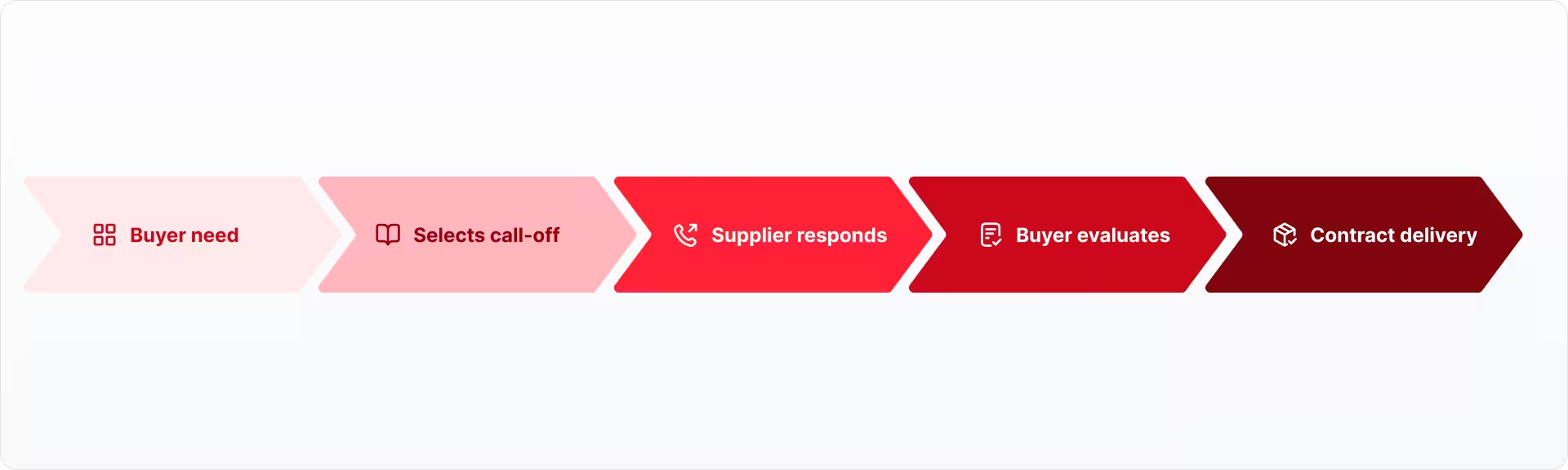
Step 1. Buyer identifies the requirement
The process begins when a buyer scopes what they need and checks which frameworks cover those goods or services. They review framework terms to confirm suitability, including whether the framework's pricing structure, supplier pool, and geographic coverage align with their requirement.
Step 2. Buyer selects the call-off method
Next, the buyer decides between direct award or mini-competition based on framework rules, contract value, and complexity. Some frameworks mandate one method over the other for certain thresholds or service types.
Step 3. Suppliers respond or receive direct award
For a mini-competition, eligible framework suppliers receive an invitation to tender within a defined timeframe. For a direct award, the buyer selects the most suitable supplier without further competition, typically based on framework pricing and past performance.
Step 4. Buyer evaluates and awards the contract
In mini-competitions, the buyer evaluates responses against stated criteria, which often assess the most economically advantageous tender based on quality, price, and social value. The winning supplier is notified, and unsuccessful suppliers receive feedback. Direct awards skip this evaluation stage entirely.
Step 5. Contract execution and delivery
Finally, the call-off contract is signed, referencing the framework's overarching terms. Delivery commences and performance is monitored against agreed KPIs and SLAs throughout the contract term.
Types of call-off awards
Two primary methods exist for awarding call-off contracts: direct award and mini-competition. The choice between them depends on framework rules, contract value, and the nature of the requirement.
Direct award
The buyer selects one supplier directly from the framework without running further competition. This approach works well when framework pricing is fixed, requirements are straightforward, or only one supplier on the framework can meet the need.
For suppliers, direct awards reward strong framework positioning and existing buyer relationships. The work tends to go to those who have already built trust with the buying organisation. Direct awards dominate the spending picture. In the chart below, you can see the percentages of direct awards vs call-offs, across UK public sector technology procurement.
Mini-competition
The buyer invites all or a subset of framework suppliers to compete for a specific requirement. Suppliers submit tailored responses evaluated against criteria set out in the invitation.
Mini-competitions are common for higher-value or more complex call-offs where the buyer wants to secure the best value. They require more effort from suppliers but offer a genuine opportunity to win work even without an existing relationship with the buyer.
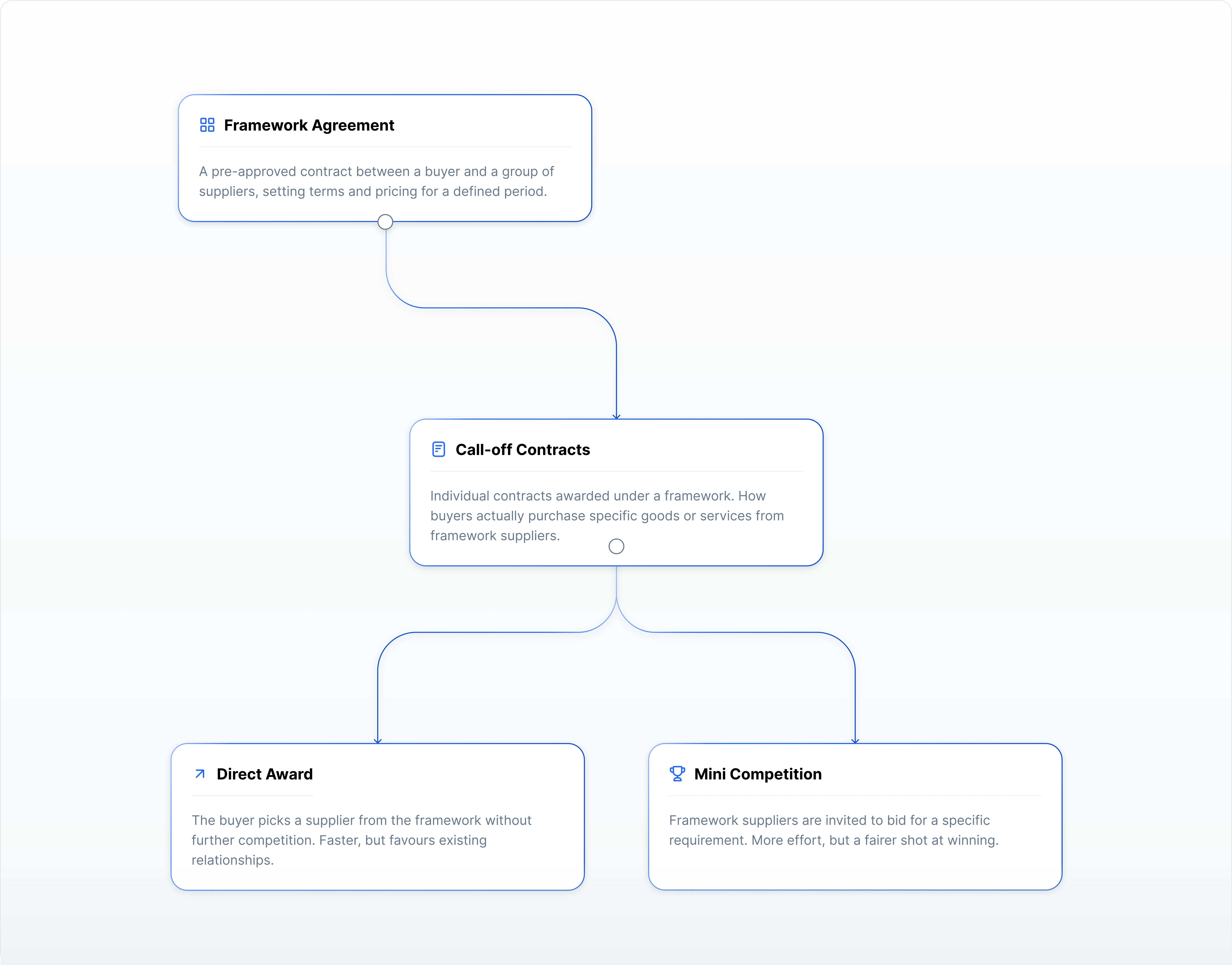
How buyers choose between direct award and mini-competition
How buyers choose between direct award and mini-competition
Most of the time, the framework terms decide. Above certain value thresholds, mini-competition is required. Below them, the buyer chooses, and the default is almost always direct award. It's quicker, simpler, and draws less scrutiny.
Mini-competitions happen when the money is large enough that someone will ask questions, when the requirement is too specific for standard framework terms, or when the buyer wants to pressure-test pricing. The last scenario is worth paying attention to — a buyer who doesn't have to compete the work but chooses to is often genuinely open to switching suppliers.
How suppliers win more call-off contracts
The suppliers who win the most call-offs aren't necessarily the biggest or cheapest on the framework. They're the ones who are paying attention before the opportunity lands.
Shape requirements before they're published. The highest-leverage move in call-off procurement is engaging buyers while they're still scoping their needs. Attending market engagement events, responding to early RFIs, and tracking buyer activity all create opportunities to influence specifications before they're locked in.
By the time a call-off is published, the winning supplier has often already helped define what "good" looks like. Another way to get ahead of call-offs are tracking contract expiries.
In the chart below, over 500 software products and platforms contracts are due to expire, along with 330 digital delivery services contracts and 136 in IT operations and support (Source: Stotles).
Invest in the buyer relationship, not just the bid. For direct awards, the buyer usually has someone in mind before the paperwork starts.
That means the real competition happened weeks or months earlier, through delivery on previous contracts, informal conversations, and simply being visible. A poor delivery on one call-off can quietly close the door on every future one from that buyer, and there's rarely a second chance to find out why.
Be ready to move fast on mini-competitions. Turnaround times on mini-comps are often tight, and buyers notice who submits polished responses quickly versus who scrambles.
Having reusable case studies, pre-drafted methodology sections, and a streamlined bid management process is the difference between competing seriously and making up the numbers.
Where to find call-off contract opportunities
Where to find call-off contract opportunities
The landscape is fragmented, which creates both challenges and opportunities for suppliers who know where to look.
Framework operator portals like Crown Commercial Service and NHS Shared Business Services publish call-off opportunities to suppliers already on the framework, but only to those suppliers, and often through dedicated portal interfaces that don't talk to each other.
Find a Tender Service captures some higher-value call-offs, though many fall below the threshold that requires public advertising. Contracts Finder shows award notices after the fact, useful for competitive intelligence but not for finding live opportunities. And individual councils, NHS trusts, and government departments each issue call-offs through their own procurement systems, meaning a single framework like G-Cloud 14 might have call-offs published across dozens of separate buyer portals.
The practical effect is that suppliers end up checking five or six portals daily and still miss relevant opportunities because there's no single place to see everything. A call-off published on one buyer's portal won't appear on another, and none of these government systems rank opportunities by relevance to your business or show you the buyer context you need to prioritise effectively.
Track framework call-offs with Stotles
Start with the Frameworks page, where you can search and browse over 25,000 framework agreements in one place. Each framework shows its signal score, stage (live, awarded, expired), total value, number of suppliers, and its call-off activity.
The "Call offs" tab tells you immediately which frameworks are generating live purchasing activity, so you can prioritise the ones worth tracking rather than monitoring every framework blind.
.webp)
Click into a specific framework, say G-Cloud 14, and you'll see call-off notices aggregated under a dedicated tab. G-Cloud 14 alone has 1,462 call-off notices, each ranked by signal score to surface the ones most relevant to your business first.
You can see the title and buyer, the supplier awarded, contract value, and publish date, all in one view.
On a government portal, you'd need to check each buyer's individual procurement page to piece this picture together, and there's no relevance ranking built in.
.webp)
The signal score is worth understanding here. On Contracts Finder or Find a Tender, every result is treated equally. You get a chronological list and manually assess whether each one is relevant. In Stotles, a call-off with a signal score of 3 has been automatically matched against your company profile, while a score of 0 means it's probably not worth your time. That distinction saves hours of manual triage that government portals simply don't offer.
Beyond the search itself, Stotles connects the framework picture to the broader buyer relationship. You can see a buyer's purchasing history, who their incumbent suppliers are, and when existing contracts are expiring. That context turns a call-off from a cold listing into an informed opportunity, and it's something no government portal provides.


Want a custom report?