The HS2 route will run 140 miles from London to Birmingham, with four stations along the way: London Euston, Old Oak Common, Birmingham Interchange, and Birmingham Curzon Street. High Speed 2 (HS2) is Britain's second purpose-built high-speed railway, designed for trains travelling at up to 225 mph.
That 140-mile stretch is what remains of a far more ambitious plan for a high speed rail line to connect the entire country together.
Back in 2012, the plan was a Y-shaped network reaching from London to both Manchester and Leeds, serving 11 cities in total.
Two rounds of cancellations, in 2021 and 2023, cut the project down to its current form.
Here's what happened to each phase:
Phase 1 (London to Birmingham): Under construction now, expected to open between 2029 and 2033
Phase 2a (Birmingham to Crewe): Cancelled October 2023
Phase 2b Western (Crewe to Manchester): Cancelled October 2023
Phase 2b Eastern (Birmingham to Leeds): Cancelled November 2021
One thing worth noting: HS2 trains will still run to Manchester, Liverpool, and Glasgow. They'll just use the existing West Coast Main Line after leaving Birmingham, rather than dedicated high-speed track.
To date, the project is being delivered through a small number of major contracts, most notably the Main Works Civils Contracts (MWCC), which group tunnels, viaducts, and stations into large delivery packages.
HS2 route on Google Maps
This blog includes four custom Google Maps covering the HS2 route from different angles:
The first shows the basic route and stations.
The second maps every major structure along the 140-mile corridor - tunnels, viaducts, and bridges - with links to the underlying procurement data on Stotles.
The third shows where the money went, with pins marking specific cost stories that illustrate why the project became so expensive.
The fourth shows the original Y-shaped network and everything that was cancelled
High speed 2 map with planned stations
This map shows the HS2 route plan as it stands today: 140 miles from London Euston to Handsacre Junction, where the line ties into the West Coast Main Line.
The four Phase 1 stations in progress are marked along with the route line.
Click any pin to see the detail.
London Euston
London terminus of HS2. Tunnelling from Old Oak Common started in January 2026, with the tunnel boring machine named "Helen" after Helen Sharman, Britain's first astronaut.
The station budget has grown considerably over time. Original estimates put the cost at £2.6bn. Current projections now exceed £7.5bn.
One of two London stops on HS2 and the interim terminus when the railway first opens. The station has six HS2 platforms and two conventional platforms.
From here, passengers can connect to the Elizabeth line, Great Western Main Line, and Heathrow Express.
Old Oak Common will serve as the main London hub until Euston is completed, making it the most important interchange on the route for the first years of operation.
Birmingham Interchange
Birmingham Interchange sits near Birmingham Airport, the National Exhibition Centre (NEC), and the M42 motorway.
Unlike the terminus stations, this is a through station where trains stop briefly before continuing on.
A people mover is planned to link the station with Birmingham Airport and the existing Birmingham International station.
The location positions it as a gateway for both business and leisure travellers heading to the Midlands.
Birmingham Curzon Street
Birmingham Curzon Street is the first new intercity terminus built in Britain since the 19th century. The station has seven platforms and is designed to be net zero in operation.
Mace and Dragados hold the joint venture contract, worth £570m.
The Grade I listed Old Curzon Street Station building from 1838 - one of the world's oldest surviving pieces of monumental railway architecture - is being restored and incorporated into the new design.
The station's design was procured through the Phase One Stations Design Services Contracts, covering Euston, Old Oak Common, Interchange, and Curzon Street across four separate lots.
HS2 Project Map: Stations, tunnels, bridges, viaducts, end marker.
This map plots every major structure along the 140-mile Phase 1 route. Stations, tunnel entrances, and over 30 bridges and viaducts are marked with engineering details and contract values. Where available, pins link directly to the underlying procurement notices on Stotles.
HS2 is building 32 miles of twin-bore tunnels and more than 50 viaducts along the Phase 1 route. Some of these structures rank among the largest civil engineering projects in Europe.
HS2 Tunnels and Viaducts
Chiltern Tunnel
At 10 miles, the Chiltern Tunnel for HS2 is the longest on the route. It passes beneath the Chilterns Area of Outstanding Natural Beauty, built to avoid surface disruption to the protected landscape.
Both tunnel boring machines have completed their drives.
The deep cuttings either side of the tunnel generated huge volumes of spoil unsuitable for reuse, and the Oakervee Review flagged spoil disposal as a major cost driver in the civils escalation.
The Euston Tunnel runs 4.5 miles from Old Oak Common to London Euston, beneath West London. The tunnel boring machine launched in January 2026. Cost estimates put this section at approximately £1bn in 2019 prices.
Northolt Tunnel
Twin-bore tunnel carrying HS2 under the suburbs of West London. Part of the southern tunnels package, which grew by £900m from its original contract value.
Bromford Tunnel
The Bromford Tunnel extends 3.5 miles on the approach to Birmingham from the east. Twin-bore construction carries trains in each direction. The tunnel connects to the Washwood Heath rolling stock depot and HS2's national integrated control centre.
Long Itchington Wood Tunnel
A 1-mile tunnel built to preserve Long Itchington Wood, a Site of Special Scientific Interest in Warwickshire. The tunnel avoids any surface-level construction through the protected area.
Colne Valley Viaduct
At 3.4km, the Colne Valley Viaduct is HS2 longest railway bridge and the longest in the UK. A gently curving structure northwest of London crossing lakes, rivers, and floodplain. Part of the same package as the Chiltern Tunnel - together they form the most expensive single civils lot on the project, estimated at £800m-1.3bn before the Align JV contract grew to approximately £1.6bn.
Why HS2 is so expensive - project problems and costs to date
This map traces the cost stories along the HS2 route. Each pin marks a specific example of where money was spent, commitments were broken, or costs escalated beyond what anyone predicted.
The tunnels and important viaducts are included for context - several of them are cost stories in their own right.
HS2 was passed through Parliament as a Hybrid Bill, which gave communities along the route the right to petition a Select Committee.
Over 2,600 petitioners appeared. Many extracted legally binding commitments - noise insulation, heritage preservation, land compensation, environmental mitigation - that became delivery obligations baked into the project.
Each one was individually reasonable. Collectively, they added billions.
The pins on this map illustrate different ways that dynamic played out: archaeological digs that turned out to be far more complex than predicted, heritage buildings where restoration stalled when funding ran out, pubs that HS2 promised to preserve and then demolished, golf courses where compulsory purchase rules turned modest land into multimillion-pound obligations, and a 1km bat tunnel that cost £119m.
Project
Cost
Details
Sheephouse Wood Bat Tunnel
£119m
1km tunnel to protect Bechstein's bats. Symbol of environmental mitigation cost escalation.
Chiltern Tunnel - Spoil Crisis
Part of £6bn civils escalation
Deep cuttings generated spoil unsuitable for reuse. Oakervee Review flagged as major cost driver.
St James's Gardens Exhumation
Part of £1bn enabling works
Europe's largest archaeological dig. 20,000+ bodies. Far deeper than surveys predicted.
Fox and Grapes Pub
Grade II - demolished 2018
HS2 promised to preserve it, then reversed course. Two of three listed pubs on the site demolished.
St Mary's Church Wendover
£250k offered / £2m claimed
Select Committee petition. Gap between offer and claim illustrates the Hybrid Bill cost dynamic.
St James's Gardens Fountain
£60k + £13.5k grant
Grade II Victorian fountain. One of hundreds of heritage obligations in the HS2 Act.
The Sheephouse Wood structure (HS2 bat tunnel) became the most visible symbol of HS2's cost problem: £119m for a 1km structure to protect Bechstein's bats. HS2's own chairman stated there was "no evidence that high-speed trains interfere with bats."
The Chiltern Tunnel, at 10 miles the longest on the route, generated its own crisis. Deep cuttings either side produced huge volumes of spoil unsuitable for reuse. The Oakervee Review flagged spoil disposal as a major cost driver in what became a £6bn civils escalation.
At Euston, the St James's Gardens exhumation became Europe's largest archaeological dig - over 20,000 bodies, far deeper than surveys predicted - contributing to a £1bn enabling works programme before main construction could even start.
And in Birmingham, the problems concentrated around Curzon Street. The Fox and Grapes pub was demolished after HS2 reversed its own plan to preserve it.
The Grade I listed Old Curzon Street Station saw its restoration paused when heritage funding ran out mid-works. Birmingham City University won a tribunal ruling allowing compensation based on development potential rather than existing use, opening the door to payouts far beyond its initial £30m claim.
The original HS2 network with cancelled legs
This map shows the full Y-shaped network as planned in 2012: London to Birmingham, splitting northwest to Manchester and northeast to Leeds. All cancelled stations are shown: Crewe, Manchester Piccadilly, Manchester Airport, East Midlands Hub (Toton), Leeds, Sheffield, and York. Compare this to the first map to see how the network shrank from 11 planned cities to 4 stations on 140 miles of track.
November 2021: Eastern leg to Leeds scrapped
Transport Secretary Grant Shapps cancelled the Birmingham to Leeds eastern leg in November 2021. Sheffield, York, and the East Midlands Hub at Toton all dropped from the network.
The route was officially "safeguarded" but received no funding. In practice, that meant the land remained protected for potential future use, though no construction would proceed.
October 2023: Everything north of Birmingham cancelled
Prime Minister Rishi Sunak cancelled all remaining Phase 2 at the Conservative party conference in Manchester. The announcement removed Crewe Hub, Manchester Piccadilly HS2, and Manchester Airport HS2 from the network.
This reduced HS2 from an 11-city network to a 4-station, 140-mile railway.
The cancellation came despite significant preparatory work already completed on the northern sections.
One framework tells the story plainly of what could have been.
Just days before Sunak cancelled the northern legs, a £300m ground investigation framework for the Birmingham to Manchester corridor, split between Aecom (£85m, management) and eight contractors including BAM Nuttall and Van Elle (£215m, physical surveys), was awarded.
The suppliers who won places on the framework will not be winning any work from it. Whatever they invested in getting on to the framework suppliers list was wasted.
How suppliers track HS2 contract opportunities
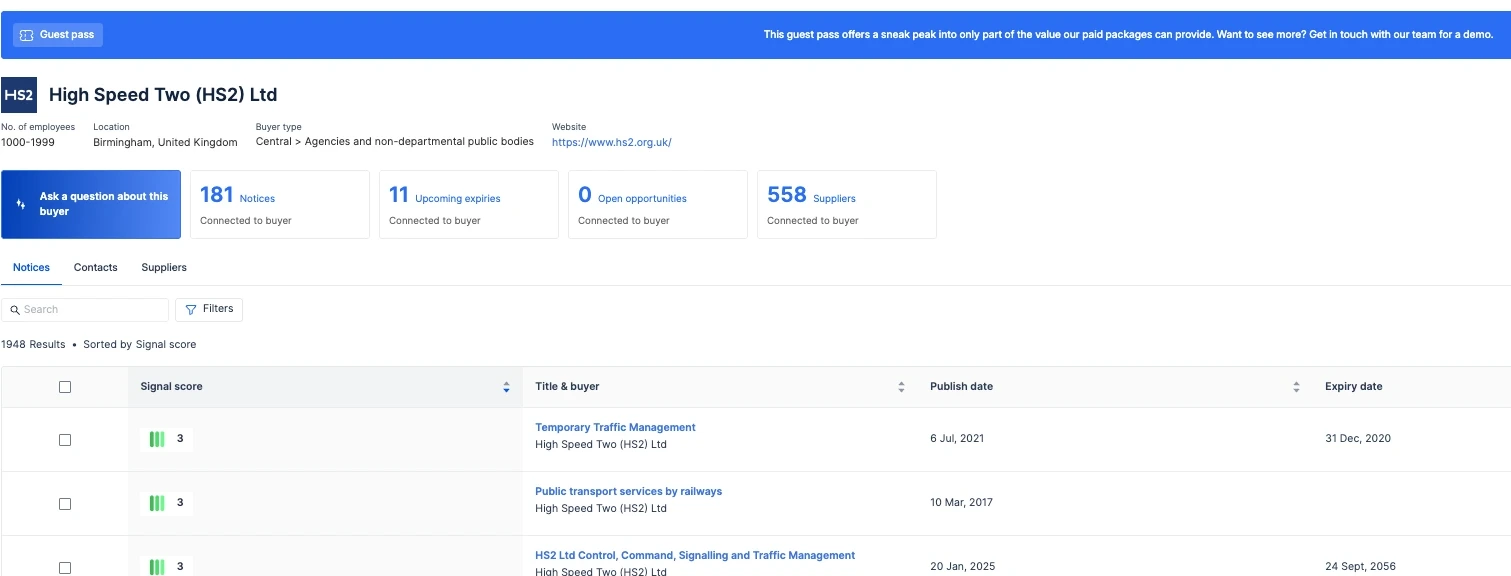
Stotles aggregates HS2-related procurement from multiple sources into a single feed through its open tender tracking feature.
Buyer intelligence reveals which organisations are commissioning work, what they have purchased previously, and which suppliers currently hold contracts or framework agreements. For HS2, that includes both HS2 Ltd directly and the major joint ventures delivering construction packages.
A sample of all of the HS2 contracts visible on Stotles, spanning Rail Systems awards, station component frameworks, and Phase Two professional services can be seen in the below table.:
Contract history shows the value and scope of previous awards, helping suppliers identify patterns in how work packages are structured and which types of organisations win them. That intelligence directly supports the bid no-bid process for each opportunity.
Tip: HS2 subcontracting often happens through Tier 1 contractors rather than HS2 Ltd directly. Tracking awards to the main joint ventures, alongside published pipeline notices, can reveal upcoming supply chain opportunities before they reach public tender portals.
Explore HS2 procurement on Stotles
This Stotles guest pass for High Speed Two (HS2) Ltd gives you a preview of the full buyer profile: 181 notices, 558 connected suppliers, upcoming contract expiries, and the complete procurement history in one view.