The UK has spent years trying to make public sector procurement more transparent. There are central notice portals, stricter publication rules, and a newer regime shaped by the Procurement Act.
If you want to understand a supplier’s real footprint in government, a simple supplier-name search is rarely enough. Notices can tell you who won, roughly what the contract covers, and how much it may be worth. They do not always show how the relationship started, how delivery is structured, whether the supplier sits inside a wider partner ecosystem, or how far that footprint extends through pilots, shared services, frameworks, and cross-government arrangements.
Palantir is a good example of this knowledge gap.
A direct supplier-name search shows a meaningful footprint in its own right. But that record still understates the full shape of Palantir’s position across the UK government. To understand that properly, you have to follow the trail beyond the surface-level notice: into consortium structures, partnership announcements, direct award patterns, published contracts, redactions, pilots, FOI responses, and supporting documents.
This is not about Palantir being unusual in particular. It is about how supplier footprints can appear in public sector markets: visible in parts, but rarely in full.
Big contracts do not always come with a full tender trail
One reason a supplier can appear smaller than it is has to do with how contracts are awarded.
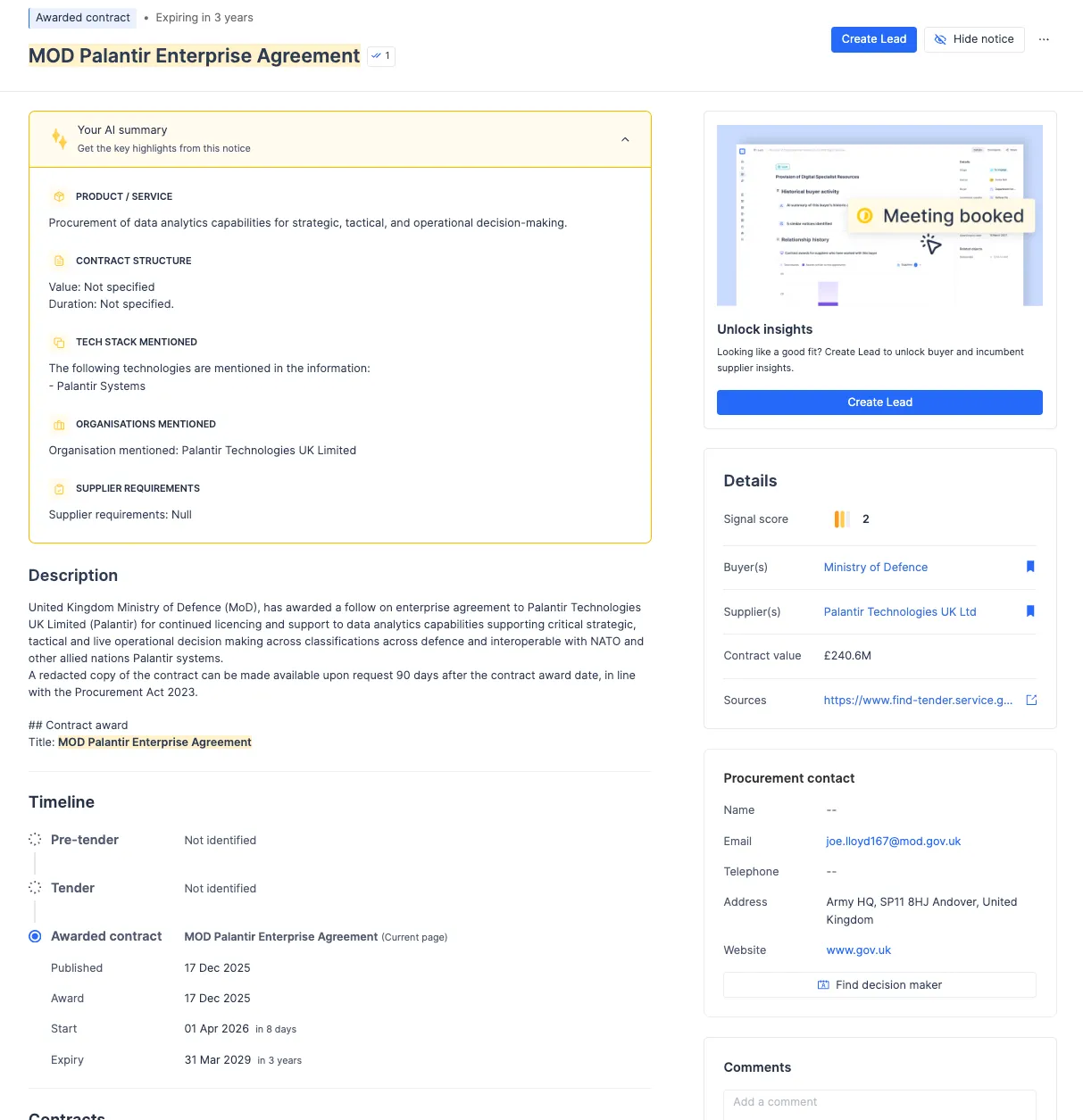
In December 2025, the Ministry of Defence published a contract award notice for the MOD Palantir Enterprise Agreement, worth £240.6 million over an estimated three years from 1 April 2026 to 31 March 2029. The notice described it as a direct award for continued licensing and support of data analytics capabilities used for strategic, tactical, and live operational decision-making across defence, including interoperability with NATO and allied systems.
That award is visible. The buying journey behind it is not.
A direct award gives competitors far less to work with than an open competition. There is no usual tender trail, no broad supplier engagement, and much less visibility into the requirement before the deal is done. The award appears in the data, but the lead-up to it is far thinner.
It also did not appear in isolation. A few months earlier, in September 2025, the MoD announced a new strategic partnership with Palantir, saying it would unlock opportunities with UK Defence worth up to £750 million over five years. Stotles data also shows this is part of a broader pattern, not a one-off win: an earlier MoD Enterprise Agreement worth £75.2 million, awarded in December 2022, plus other contracts for data integration services, software licensing, and extensions.
Why should suppliers care?
A notice may show the outcome, but not the momentum behind it. If you only count awards, you may miss the fact that the buyer-supplier relationship is already deep, expanding, and increasingly sticky.
The named supplier is not always the full picture of the delivery
The NHS Federated Data Platform is the clearest example related to Palantir.
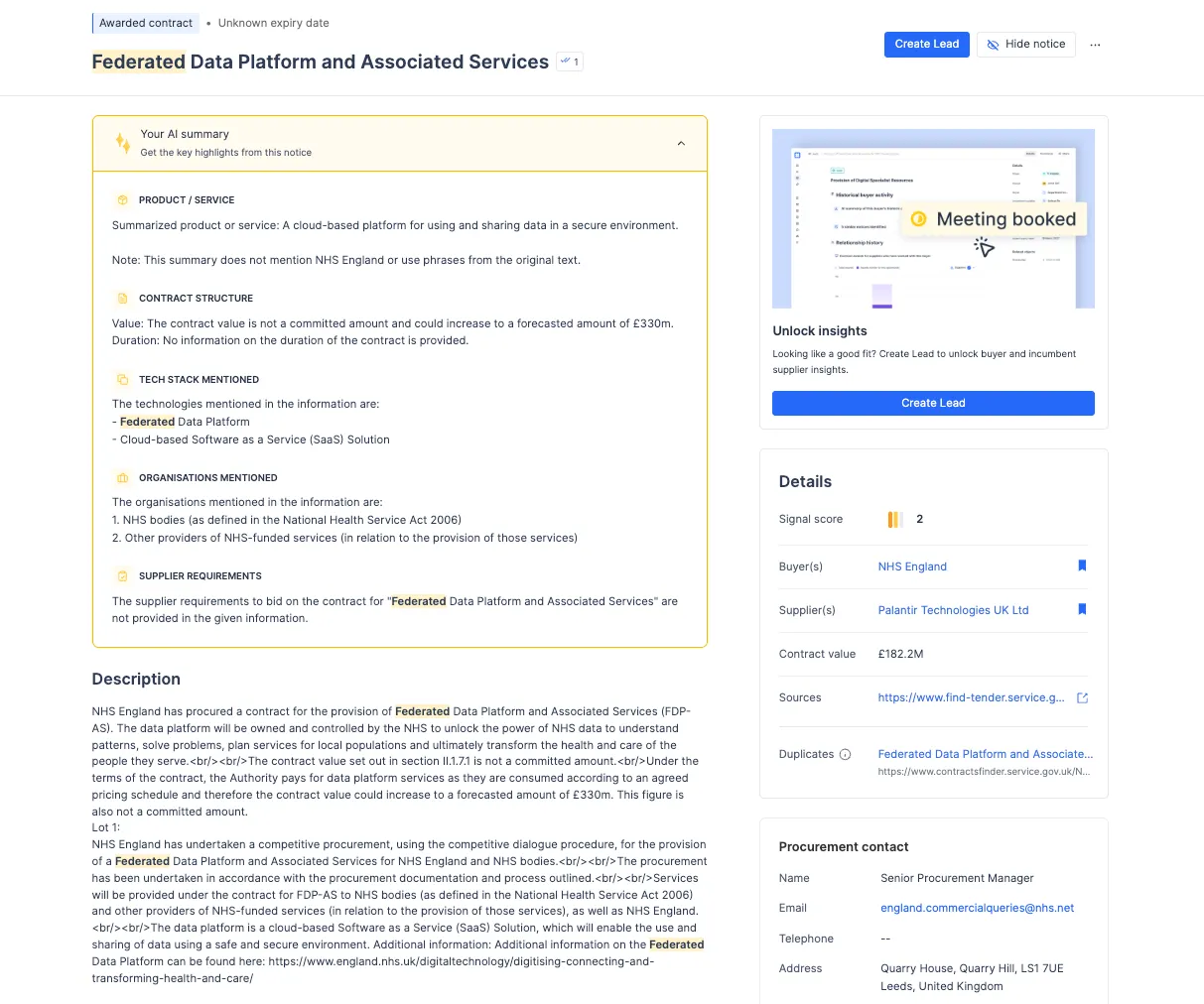
In November 2023, NHS England announced that the FDP contract had been awarded to a consortium led by Palantir, alongside Accenture, PwC, Carnall Farrar and NECS. NHS England also described the programme as worth up to £330 million over seven years as more trusts join the platform.
That matters because the supplier named in the notice is not always the only supplier that matters. Some contracts are delivered through groups of suppliers while others rely on systems integrators, implementation partners, subcontractors, or reseller arrangements. If you only track the prime, you risk overlooking the broader ecosystem surrounding the work.
The footprint is not one contract. It is a chain of platform, transition, extension, and support agreements that build a much bigger commercial picture over time.
Transparency on paper does not always mean clarity in practice
Even when a major award is public, the detail that matters most can still be hard to access.
The FDP shows that clearly. In February 2024, the BMJ reported that NHS England faced legal action after contracts for the programme were published with large sections redacted. According to the report, 417 of 586 pages in the Palantir contract were redacted, including key sections on how patient data would be handled.
That does not make the contract invisible. But it does limit what a competitor, analyst, journalist, or potential partner can learn from the public record.
Why should suppliers care? For suppliers, that matters because procurement intelligence is not just about spotting an award. It is about understanding what was bought, how it will be used, how embedded the incumbent is, and where the next entry point might be. A contract can be published and still leave major commercial questions unanswered.
Some deployments sit outside the contract trail that suppliers expect
Not every Palantir-linked deployment appears as a clean, department-level contract award.
Take policing. In July 2025, the East Midlands Special Operations Unit said it had contracted Palantir Technologies as part of a Home Office-funded pilot called Project Nectar, initially launched within Bedfordshire Police, to test Palantir Foundry for operational policing. The update said the pilot would bring together data from multiple sources into a unified view and test automation, AI-supported summarisation, and language translation.
That is a useful reminder that supplier footprint often spreads through pilots, shared capabilities, regional programmes, and centrally funded initiatives before it shows up in a large, obvious contract trail.
None of these are on the scale of the MoD or NHS work. But they show how a footprint grows. A supplier lands a pilot, proves value, expands use cases, and builds toward something larger.
Cross-government services create another layer of complexity. A Defra FOI response said Defra did not hold a direct contract with Palantir, but that the Cabinet Office held and managed the contract for the Border Flow Service. The same response said Defra had a data-sharing agreement and memorandum of understanding with the Cabinet Office to share data into that service, which was hosted in a private Palantir cloud.
Why should suppliers care?
That is exactly the kind of arrangement a supplier can miss if they only run a direct supplier-name search against one department.
If you want to understand a supplier’s real public sector footprint, start with the notice, but do not stop there. Ask a wider set of questions:
Is the supplier the prime, or part of a group of delivery partners?
Is delivery routed through partners, resellers, or framework holders?
Was this won through open competition, direct award, pilot, or extension?
Does the published value reflect committed spend, a maximum envelope, or a wider programme number?
Are there linked contracts for transition, support, rollout, or exit?
Has the contract been published in a way that still leaves key details obscured?
Is the service being used by departments that do not hold the contract directly?
Are there pilots, FOIs, partnership announcements, or supporting documents that show a broader footprint?
These are not edge cases. They are a normal part of how large public sector technology relationships show up in the market and what the most successful sales teams are monitoring when selling into the public sector.
For suppliers, this matters for four reasons.
First, it helps you identify competitors more accurately.
Second, it helps you see where partnerships or reseller relationships may be the smarter route to market.
Third, it helps you spot how entrenched an incumbent really is before you decide whether to challenge.
Fourth, it helps you find the next opportunity window, whether that sits in a renewal, an extension, a pilot expansion, or a surrounding services requirement.
The bigger takeaway
Palantir is not invisible in UK public procurement. There are major awards in plain sight, from the MoD’s £240.6 million direct award to the NHS FDP programme and the surrounding support and extension work. But if you rely only on surface-level notices, direct supplier-name searches, and raw contract counts, you will almost certainly understate the company’s position.
Procurement notices are an essential starting point. They are not the full map.
Suppliers that want to build a sharper public sector sales strategy need to go further. So follow the documents, check the delivery model, read the published contract, trace the partner network, interpret the value carefully, and look for the routes to market that sit behind the award.
Frequently asked questions
What is a supplier footprint in government procurement?
A supplier's footprint covers the full extent of their presence across the public sector: contracts, pilots, framework call-offs, consortium arrangements, and cross-government service agreements. A notice search will show you part of it. It rarely shows all of it.
Why don't procurement notices show the full picture?
Notices capture outcomes, not journeys. A direct award leaves no tender trail. A consortium win names the prime, not the full delivery chain. Pilots and FOI-disclosed arrangements may not appear in the central record at all. Each gap means a notice-only view will understate how embedded a supplier actually is.
What is a direct award and why does it matter for competitors?
A direct award is a contract given without open competition, usually under a framework or on continuity grounds. There is no tender trail to analyse and no pre-market engagement to participate in. The relationship moves from existing to extended with very little public visibility into the terms or scope.
How do suppliers use pilots to build a public sector footprint?
A pilot gives a supplier a funded entry point to prove value at low risk to the buyer. If it lands well, it expands into broader use cases, additional sites, or a larger follow-on contract. Tracking small pilots helps you see where a footprint is growing before it becomes a major award.