


What is a contract award?

A contract award is the formal decision to award a contract to a selected supplier at the end of a tender or competition. The buyer selects the supplier based on the published award criteria (for example, price and quality), issues an award decision, and completes any required notices, such as a contract award notice and, where applicable, a standstill period. In public procurement, a contract can also be awarded directly without competition in limited, legally permitted situations, and awards under frameworks may have specific notice and call-off rules.
For suppliers selling to government, contract awards represent both an endpoint and a starting point.
Every contract award published is one piece of a much larger picture. The UK public sector awarded £434 billion in procurement spending in 2024/25, and that total has grown 23% since 2020/21.
They signal who won, but they also reveal market patterns, incumbent relationships, and future opportunities.
This guide covers how the award process works, what information gets published, and how to turn award data into competitive intelligence.
How contract awards work in UK public procurement
In everyday language, the term contract award refers to two distinct moments. First, there's the internal award decision, when the buyer picks the winner.
Then there's the contract award notice, the public announcement published after both parties sign.
Most people use "contract award" to mean both, so context matters.
The path from bid submission to signed contract follows a fairly predictable sequence. Timelines vary depending on complexity and value, but the steps remain consistent.
The contract award process
The contract award process runs from evaluation through to contract signature.
Each stage has a specific purpose, and for suppliers, each one creates a different window to gather intelligence or take action.
The sequence process follows 4 steps: buyer evaluation, supplier notice, standstill period, and contract award notice.
1. Evaluation and scoring
After the tender deadline closes, the buyer's evaluation panel reviews each submission against the criteria published in the tender documents.
Most UK public sector procurements use the Most Economically Advantageous Tender (MEAT) approach, which balances quality and price according to stated weightings.
Evaluators score responses independently first, then come together as a panel to moderate.
Everything gets documented for audit purposes. This is why feedback requests after an unsuccessful bid can reveal useful insights about how the scoring actually worked.
2. Award decision and notification
Once scoring is finalised, the buyer makes an internal award decision and notifies all bidders.
Both successful and unsuccessful bidders receive notification letters, sometimes called Award Decision Notices. Previously, under the Public Contracts Regulations of 2015, Regulation 86 letters were used as notifications of contract awards.
Unsuccessful bidders can request the characteristics and relative advantages of the winning bid.
This transparency requirement exists so bidders can meaningfully challenge the decision if something went wrong, and that challenge window is what the next stage protects.
3. Standstill period
Between the award decision and contract signature, a mandatory standstill period applies to above-threshold procurements.
This pause, sometimes called the Alcatel period after the European Court case that established it, typically lasts 10 calendar days.
The standstill gives unsuccessful bidders time to request feedback and review the decision. Once the contract is signed, challenging becomes significantly harder.
4. Contract signature and award notice
The contract award is only complete when both parties sign the agreement. The contract award date typically refers to this signature date, not the earlier decision date.
After signature, the buyer publishes a contract award notice on the relevant procurement portal.
This is the point at which the award becomes public record, and it's the data that matters most for suppliers tracking the market.
What information appears in a contract award notice
Contract award notices are the official public record of contracts awarded by government buyers. They appear on procurement portals after the contract is signed and follow a standardised format.
Below is a contract award notice for the Euston Station Over Site Development, a 25-year master development partner contract awarded as part of the HS2 rail project.
We'll use it to walk through the key fields that appear in a typical notice.
Award title and description
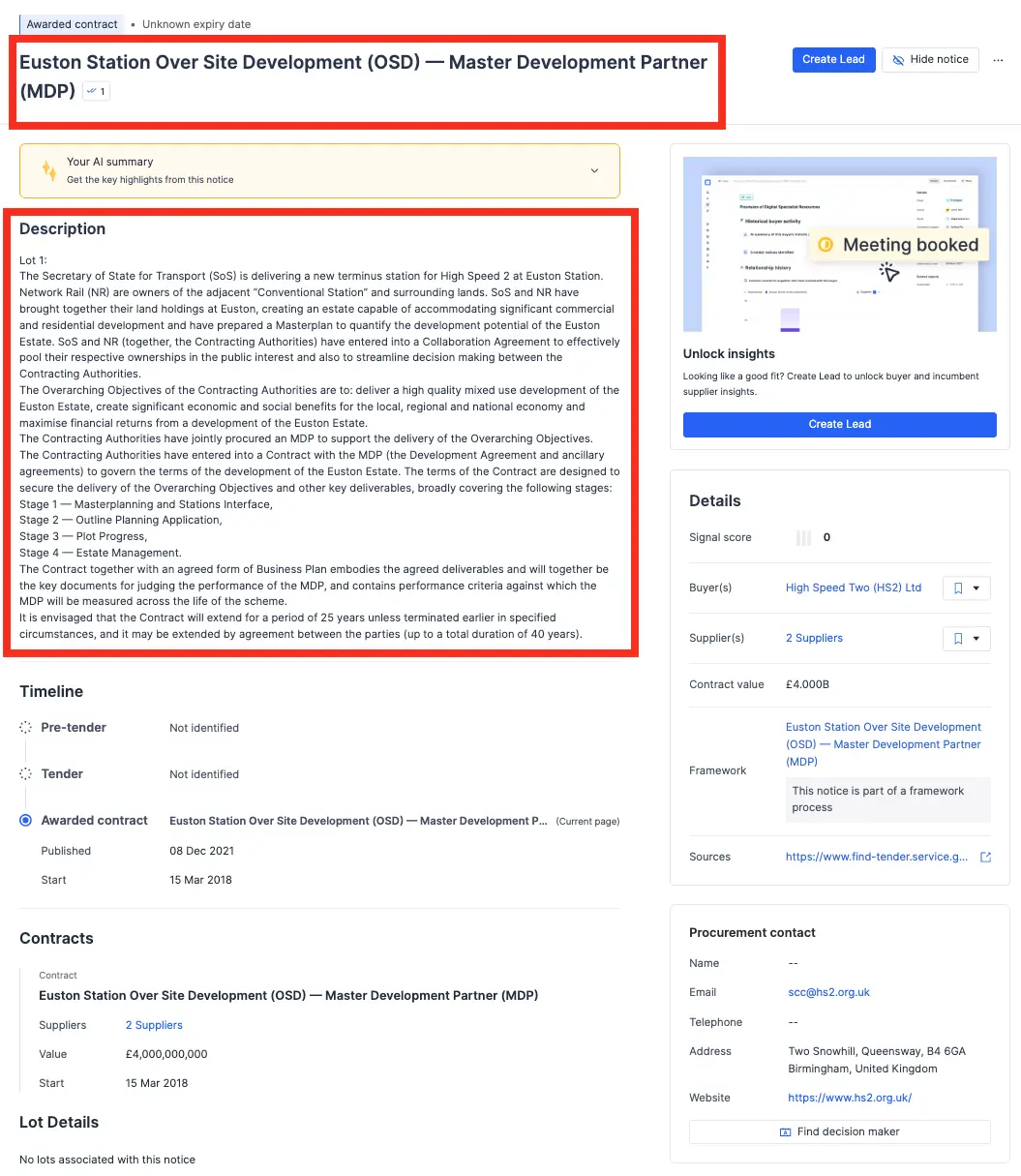
Every notice starts with a title and description summarising the scope of the contract. In this case, the title identifies the specific HS2 workstream (Euston Station Over Site Development) and the role being procured (Master Development Partner).
The description sets out the background, the contracting authorities involved, the deliverables across four stages, and the contract duration.
This is the first thing suppliers see when scanning awards, and it's how most search tools index notices.
Vague titles are common, which is why the description matters or other factors like CPV code.
Winning supplier and contract value
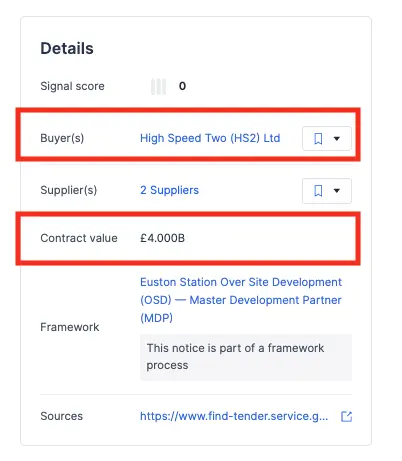
The notice identifies the government buyer or buyers (High Speed Two in this case), along with the contract value of £4 billion.
Some notices show estimated values rather than final figures, particularly for framework agreements where actual spend depends on call-off activity over time.
But even estimated values are useful, tracking which suppliers win contracts with specific buyers builds a picture of incumbent relationships and competitive positioning across the market.
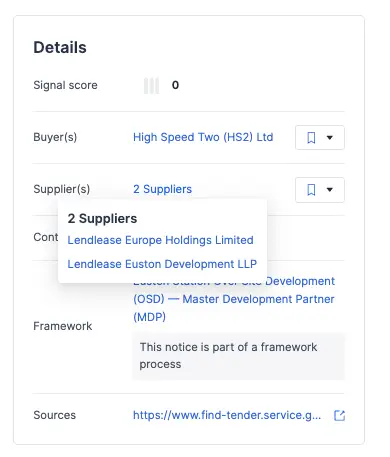
After that, the supplier is labeled. Here, two Lendlease entities were awarded the contract.
Timeline and contract dates
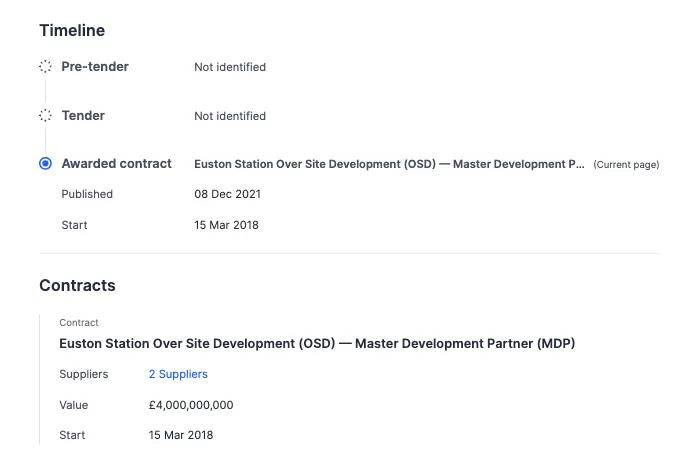
Award notices include key dates: when the notice was published, when the contract started, and sometimes when it expires.
For the Euston Station contract, the start date is March 2018 with the notice published in December 2021.
The gap between start and publication is common. What matters for suppliers is the contract duration and expiry, since these signal when a contract expires and when competition can begin anew.
A contract starting in 2018 with a 25-year term tells you this buyer is locked in, but subcontracting and adjacent opportunities may still exist.
Buyer organisation and contact details
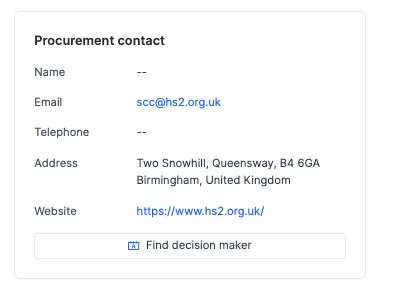
Each notice identifies the contracting authority and often includes contact details. Here the buyer is High Speed Two (HS2) Ltd, with an address and email listed.
This information helps suppliers understand which organisations procure specific services and, where contacts are named, who to approach ahead of future tenders.
Types of government contracts awarded
Different procurement routes produce different types of awards. Each has distinct characteristics worth understanding.
Open tender awards
Open tender awards result from fully advertised competitive procurements where any supplier meeting the selection criteria could bid.
These are the most visible awards and appear prominently on central portals like Find a Tender and Contracts Finder.
Framework call-off awards
Framework call-off awards occur when a buyer selects a supplier from a pre-established framework agreement.
The buyer might run a mini-competition among framework suppliers or make a direct award based on framework terms.
These awards may not always be advertised in advance, but they still get published as contract award notices. Frameworks operated by Crown Commercial Service generate thousands of call-off awards each year.
For example, G-Cloud 14, a software specific framework has 1,400 call-off notices associated with the overall framework.
.webp)
Dynamic Purchasing System awards
A Dynamic Purchasing System (DPS) is an electronic system that remains open to new suppliers throughout its duration.
Awards under a DPS follow mini-competitions among qualified suppliers.
Unlike frameworks, suppliers can join a DPS at any point. This makes DPS arrangements more accessible for organisations building their public sector presence.
Direct awards and single tender actions
Buyers can sometimes award contracts without competition.
Grounds include genuine urgency, technical reasons limiting supply to one provider, or values below procurement thresholds.
For above-threshold direct awards, buyers may publish a Voluntary Ex Ante Transparency (VEAT) notice announcing their intention. This provides a limited challenge window before contract signature.
Why awarded government contracts matter for suppliers
Contract award notices are a public record, but for suppliers selling to government they're also a source of competitive intelligence.
The data in each notice (who won, at what value, with which buyer, and when the contract expires) compounds when you track it systematically.
Understanding who wins and why matters because the market is concentrated. Incumbency is strong, and most suppliers are working with a small number of wins at any one time.
Know who you're bidding against
Before responding to any tender, you need to know who holds the current contract. Award data tells you. But the real value comes from aggregating that data across a market to see which suppliers dominate, where they're concentrated, and where gaps exist.
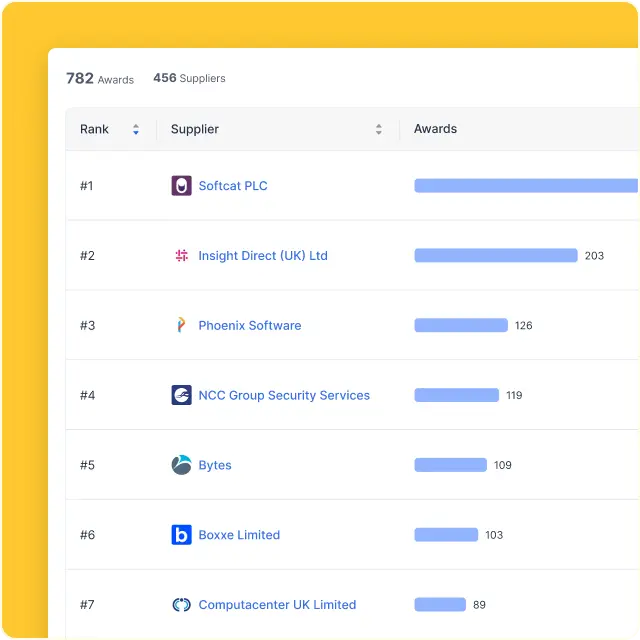
The supplier ranking below shows 782 awards across 456 suppliers in a single sector.
Softcat leads, followed by Insight Direct and Phoenix Software.
If you're selling IT services to the public sector, this is your competitive landscape, and it tells you exactly who you'll be displacing on any given bid.
This kind of incumbent mapping shapes how you position.
Bidding against a supplier with 200+ awards in a sector is a different proposition to challenging one with a handful. It also reveals which buyers are spread across many suppliers (and may be open to switching) versus those locked into a single relationship.
Spot expiring contracts in advance
Every awarded contract has an end date. That expiry is the earliest signal that a new procurement is coming, often months or years before a tender notice appears.
The expiring contracts view below surfaces contracts approaching their end date, sorted by relevance.
A CRM contract with Edinburgh University Press expiring in six months, an air quality management contract with Greater London Authority expiring in three months, a data analytics contract with NHS England expiring in three months.
Each one is a potential opportunity that most suppliers won't see until the tender goes live.
.webp)
This is where award data becomes pipeline.
If you can see that a contract is expiring and you know who the incumbent is, you can start the conversation with the buyer before the formal process begins.
By the time the tender is published, you're already positioned.
How to use contract award data for competitive intelligence
Award data becomes actionable intelligence when analysed systematically rather than reviewed ad hoc.
- Incumbent mapping: Identify current suppliers before pursuing a tender. Understanding who holds the relationship shapes positioning strategy.
- Win/loss analysis: Track competitor patterns across buyers and sectors. Spot trends in award decisions over time.
- Buyer profiling: Build a picture of what specific buyers purchase, their typical contract values, and preferred frameworks.
- Framework prioritisation: See which frameworks generate the most awards in your sector. Focus accreditation efforts accordingly.
Competitive intelligence and expiry tracking are useful on their own, but they work best when combined. Knowing that a contract expires in 12 months is a signal.
Knowing who the incumbent is, what the buyer's pain points are, and whether the contract is likely to be renewed: that's a qualified lead.
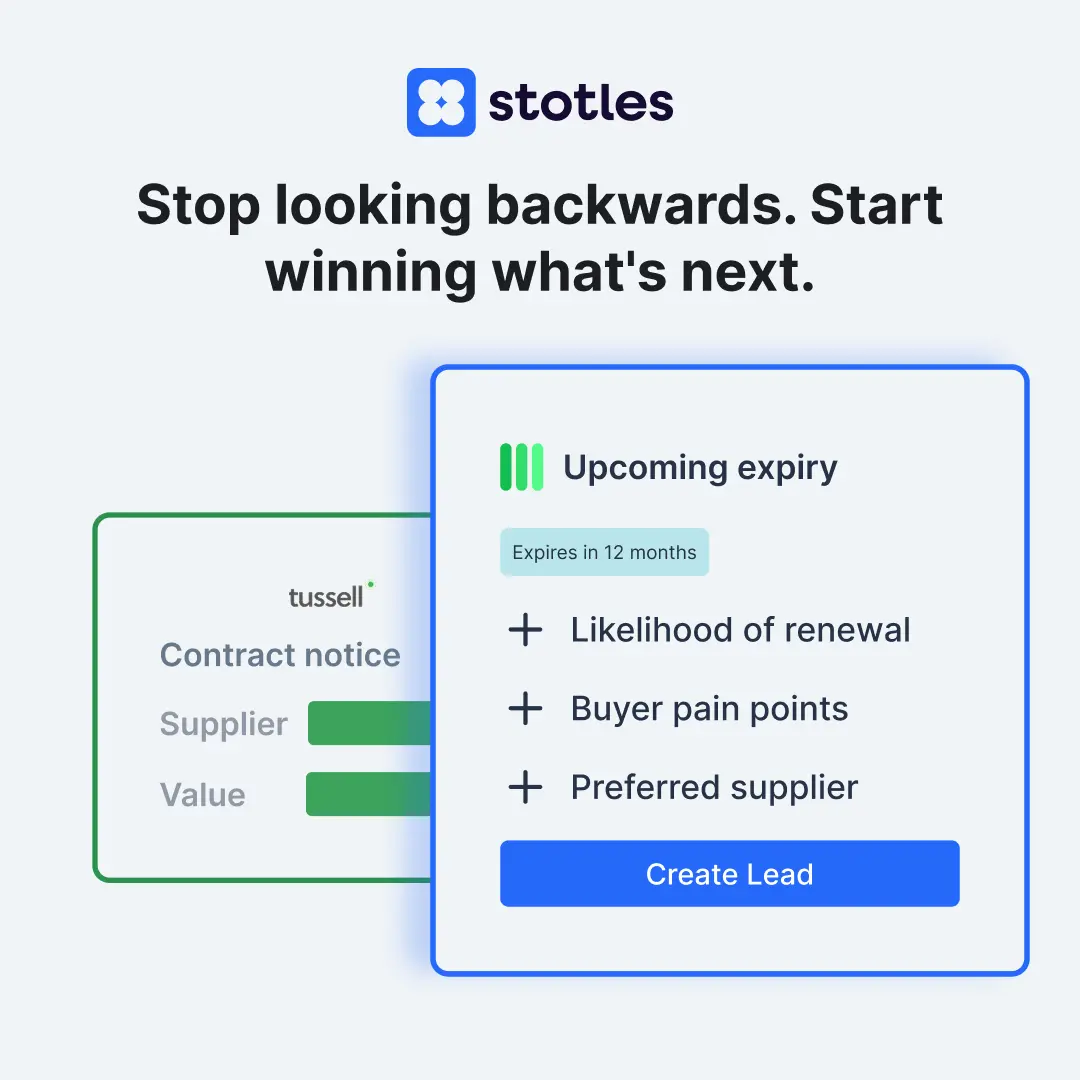
This is the shift from looking backwards at historical awards to using them to win what's next.
The award notice tells you what happened.
The expiry, the incumbent, and the buyer context tell you what to do about it.
Where contract awards are published
Contract award notices are spread across multiple portals.
Find a Tender covers above-threshold UK contracts. Contracts Finder covers English public sector contracts, including lower-value awards.
Scotland, Wales, and Northern Ireland each operate their own portals (Public Contracts Scotland, Sell2Wales, and eTendersNI respectively).
On top of that, framework operators like Crown Commercial Service publish call-off awards on their own platforms, which don't always appear on the central portals.
No single source captures everything, which is why most suppliers either dedicate significant time to checking multiple sites or accept gaps in their visibility.
Stotles consolidates contract award notices from over 100+ procurement portals into a single searchable feed, including Find a Tender, Contracts Finder, devolved administration portals, and framework-specific platforms.
Instead of checking five or six sources manually, suppliers can track awards, filter by sector or buyer, and surface relevant contracts in one place.
The volume of contract award notices published across UK portals has grown significantly in recent years, with monthly award volumes regularly exceeding 8,000 notices.
Tracking contract awards with Stotles
Stotles brings together contract award notices, incumbent supplier data, and expiry signals from across the UK public sector in one platform.
See which suppliers are winning, spot recompetes before they're advertised, and build qualified pipeline from award data.


Want a custom report?