

UK government contracts awarded
Where to find contract award notices, and how to read them. Awarded work tells you who is buying, from whom, and when it comes round again.
See who's winning public sector contracts across the UK and Ireland, and spot expiring contracts to target next.
Live opportunities matched to what buyers are publishing right now.
Free tools, guides, and directories to help you find and win public sector work.
Where to find contract award notices, and how to read them. Awarded work tells you who is buying, from whom, and when it comes round again.
G-Cloud spend broken down by lot, sector and supplier size. Where the money has gone, and which lots are worth bidding for.
What a contract award notice is, and why it is now published before signature. What that change means for suppliers watching an award.
100M+ fragmented public sector data points turned into buyer signals. Track tenders, contracts and frameworks in one place.
Sopra Steria sues DWP after Capita won a £958.7m contract at £370m. What the low-bid dispute signals for central gov bidders.
Chasing published tenders wins only 4% of the time. What the top-performing suppliers on Stotles do instead.
Frequently asked questions about contract award notices and building pipeline from them.
A contract award notice is the formal publication that confirms a public sector buyer has awarded a contract to a supplier. Under the Procurement Act 2023, buyers must publish an award notice at the point of award and observe an 8-working-day standstill period before the contract can be signed. The notice sets out who won, the value, the scope, and the contract duration.
A typical award notice includes:
The duration is the detail that matters most for pipeline building. It tells you when the same requirement will come back to market.
Every award is a future tender. Public sector contracts have finite terms, usually two to five years, and re-procurement typically starts six to twelve months before the current contract expires. Award notices tell you:
Working backwards from award end dates lets you build a qualified pipeline before opportunities are advertised. That pre-tender window is when incumbents are most exposed and challengers can shape the requirement.
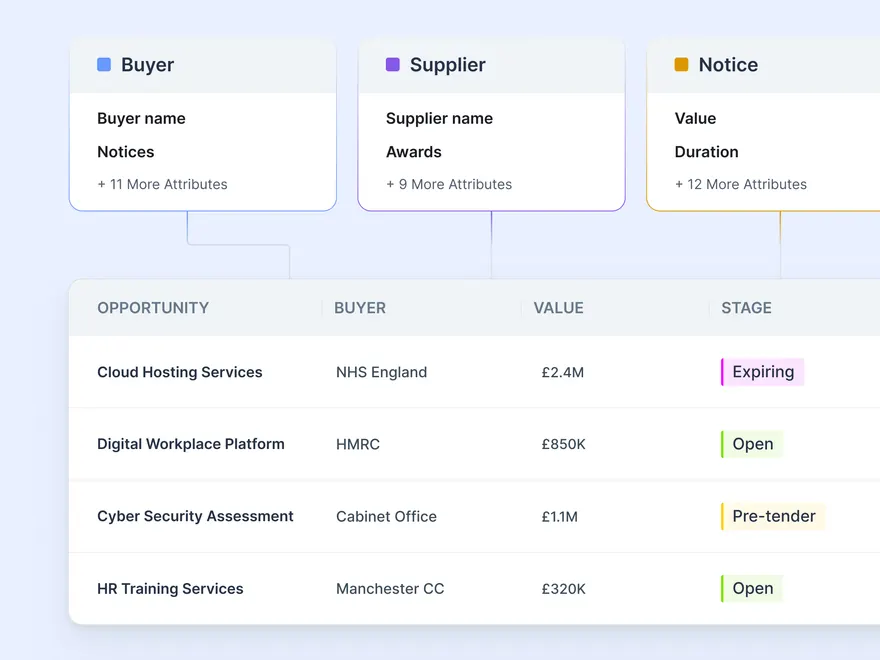
Expiry dates come from the contract duration published in the award notice. Stotles tracks 48,160 upcoming contract expiries across UK public sector buyers and surfaces them by buyer, supplier and category. That lets you prioritise the incumbents most vulnerable to challenge and pre-engage buyers before the next tender is drafted. See how expiring contracts fit into the wider workflow on our build pipeline page.
Award notices are published across several sources:
The same problems that apply to open tenders apply here: fragmented sources, inconsistent CPV tagging and duplicate records. Stotles aggregates award notices from 100+ sources into a single searchable list of awarded government contracts, filterable by buyer, supplier, CPV code, value or award date.
Competitive award. The contract is awarded following an open or competitive flexible procedure, with published notices and evaluation criteria.
Direct award. The buyer awards the contract to a specific supplier without a competitive process. Under the Procurement Act 2023, direct awards are permitted only in narrowly defined circumstances, such as extreme urgency or absence of competition, and the buyer must publish a transparency notice before signing.
Both types produce a contract award notice, and both feed into the same expiry data you can use for pipeline planning.
UK public sector buyers publish new awards every working day. Stotles adds around 2,209 new award notices in the trailing seven days on average. Set alerts by buyer, supplier or CPV code to see relevant awards as they land, and let expiring incumbent contracts feed straight into your pipeline.
Track opportunities, buyer intelligence and bid tools — all in one place.